Tapo Deadbolt Smart Lock Spec Breakdown: DL100 vs DL110 vs DL130
Selecting the right tapo deadbolt smart lock depends on matching your entryway to the correct authentication hardware, power architecture, and structural durability rating. Modern motorized deadbolts have progressed beyond basic digital keypads, offering diverse options ranging from tactile mechanical push-buttons to sub-second capacitive fingerprint readers and sub-dermal palm vein scanners. For property owners evaluating smart…

As Amazon Associates, we earn from qualifying purchases. This means we may receive a small commission at no extra cost to you if you click through and make a purchase.
Selecting the right tapo deadbolt smart lock depends on matching your entryway to the correct authentication hardware, power architecture, and structural durability rating. Modern motorized deadbolts have progressed beyond basic digital keypads, offering diverse options ranging from tactile mechanical push-buttons to sub-second capacitive fingerprint readers and sub-dermal palm vein scanners. For property owners evaluating smart locks, the primary considerations come down to how users authenticate at the door, how the lock maintains continuous power during outages or cell depletion, and whether the internal deadbolt motor and latch assembly meet recognized residential security standards.
This article covers exactly three products: the Tapo DL100, the Tapo DL110, and the Tapo DL130. While all three models integrate seamlessly into the TP-Link Tapo management ecosystem, their hardware platforms differ significantly. The DL100 focuses on backlit tactile keypad entry powered by standard AA alkaline cells and backed by a BHMA Grade 3 physical rating. The DL110 introduces biometric access via an ultra-fast 0.42-second fingerprint scanner and shifts power delivery to a rechargeable one-year battery pack. At the top of the line, the DL130 incorporates contactless AI palm vein recognition, an uninterruptible dual-battery system, AES-128 local data encryption, and an upgraded BHMA Grade 2 structural rating for superior resistance against forced physical entry.
Which Tapo Smart Locks Should You Buy
- For property managers, rental units, and homeowners wanting classic pushbutton access with replaceable AA batteries: Tapo Smart Wi-Fi Deadbolt Door Lock (DL100).
- For busy households requiring rapid biometric verification and a single long-lasting rechargeable battery: Tapo Smart Wi-Fi Door Lock (DL110).
- For premium entryways requiring contactless palm vein authentication, maximum physical door hardening, and uninterrupted dual-battery power: Tapo Smart Door Lock Wi-Fi Deadbolt (DL130).
Tapo Smart Wi-Fi Deadbolt Door Lock
Buyer favourite4.7 or better on Amazon’s buyer average
Price not listed
4.9 average from Amazon buyersOverwhelmingly positive
Brand Tapo ASIN B0F5BH3HDV
Best for: Rapid fingerprint recognition with minimal battery maintenance
Pros
- 42-second fingerprint scan
- 1-year rechargeable battery
- Stores 100 fingerprints
- Six access modalities
Cons
- No listed BHMA grade
- Lacks palm vein scanning
Best for: Keypad simplicity and replaceable AA battery operation
Pros
- BHMA Grade 3 certified
- Up to 200 passcodes
- Scramble code protection
- Emergency USB-C terminal
Cons
- No biometric sensor
- Requires disposable AA cells
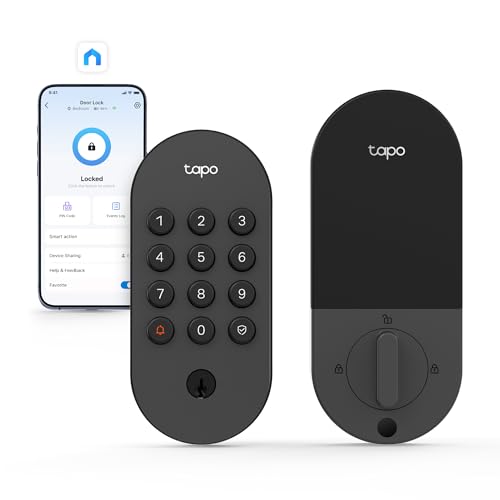
The Tapo Smart Wi-Fi Deadbolt Door Lock (Model DL100) serves as the dedicated keypad solution in the Tapo deadbolt lineup, engineered for users who prioritize tactile feedback and simplicity over biometric sensors. The exterior escutcheon features a physical, backlit push-button matrix that accommodates up to 200 custom user codes. This makes the DL100 an exceptional choice for busy families, rental properties, and maintenance staff who need simple, reliable access without smartphone dependencies. To mitigate code eavesdropping, the lock incorporates a random-digit scrambling algorithm, which allows users to enter arbitrary numbers before or after their actual passcode to prevent onlookers from discerning the sequence. When evaluating button responsiveness and numeric capacity against traditional electronic hardware such as a kwikset keyless entry door lock smart deadbolt, the DL100 delivers substantial flexibility with comprehensive in-app credential management.
Power management on the DL100 relies on four standard AA alkaline batteries, which come included with the hardware. Under typical operational loads, this power pack delivers up to 200 days of endurance when connected directly to 2.4 GHz Wi-Fi, or up to 300 days when operating purely over local Bluetooth. Should the primary AA cells deplete before replacement, an exterior emergency USB-C port enables users to jump-start the deadbolt motor using a standard portable power bank, while two traditional physical backup keys provide a completely non-electronic entry method. The lock housing carries an IP54 weatherproof rating to resist splashing water and dust, while the internal mechanical components earn an official BHMA Grade 3 durability certification for long-term cycle reliability.
Where the DL100 yields to higher-tier models is in authentication speed and biometric capability: because it lacks optical or capacitive scanning hardware, every keyless entry requires physically typing a PIN code on the keypad or issuing an app command. For access security, the DL100 includes an automatic locking feature with user-defined delay intervals, alongside a built-in PIN attempt limiter that temporarily freezes the keypad after repeated incorrect entries.
- BHMA Grade 3 certified durability paired with an IP54 weatherproof housing
- Backlit tactile keypad supporting up to 200 customizable user codes with scramble protection
- Dual battery runtime ratings of up to 200 days via Wi-Fi and 300 days via Bluetooth
- Emergency USB-C external power interface and two physical mechanical backup keys
Tapo Smart Wi-Fi Door Lock

Buyer favourite4.7 or better on Amazon’s buyer average
Price not listed
4.7 average from Amazon buyersOverwhelmingly positive
Brand Tapo ASIN B0DKQQ6Z7Q
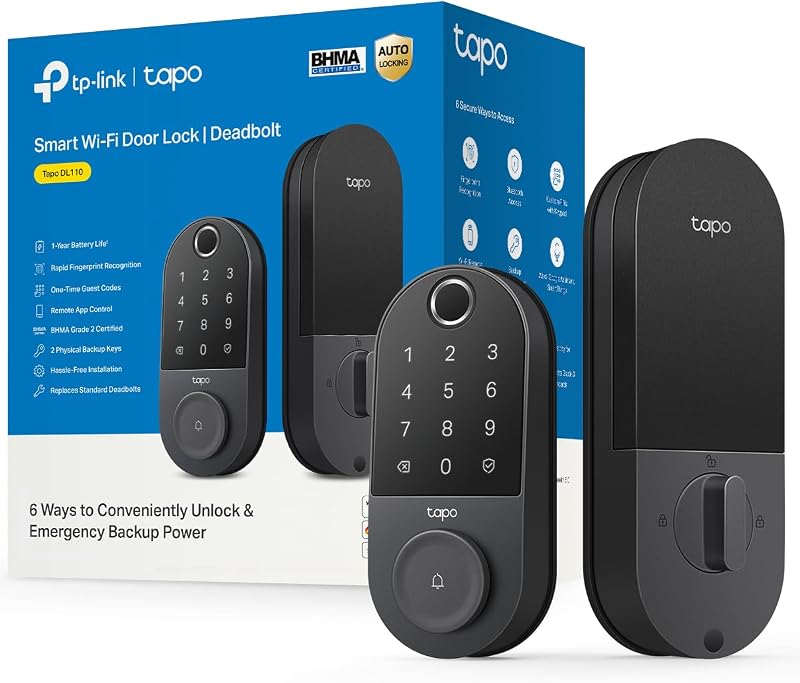
The Tapo Smart Wi-Fi Door Lock (Model DL110) transitions the brand’s security hardware into biometric authentication by embedding a rapid capacitive fingerprint sensor directly into the lock interface. Engineered to eliminate the friction of entering digit codes, the DL110 recognizes enrolled prints and actuates the motorized deadbolt in just 0.42 seconds. The internal storage module retains up to 100 individual fingerprint profiles, accommodating large families, extended guests, and service personnel. In any direct tapo dl100 vs dl110 comparison, the DL110 stands out by streamlining daily entry into a single physical touch, moving away from the purely numeric keypad layout of the base model.
Power engineering also sees a fundamental redesign in the DL110. Instead of replaceable alkaline cells, this deadbolt utilizes a high-capacity removable and rechargeable battery pack that provides up to one full year of continuous operation under normal use. Recharging is handled via an integrated USB-C port, minimizing ongoing battery replacement costs. Beyond biometric scanning, the DL110 supports six discrete access methods: fingerprint recognition, custom keypad passcodes, remote mobile unlocking via Wi-Fi, localized short-range Bluetooth access, smart home voice commands through Amazon Alexa, Google Home, or Samsung SmartThings, and physical mechanical keys. Property owners comparing smart deadbolt versatility with established brands like schlage door locks and deadbolts will appreciate the DL110’s wide range of wireless and biometric redundancies.
The Tapo companion app enables fine-grained access control, allowing administrators to establish permanent profiles for residents, time-restricted schedules for recurring visitors, or single-use passcodes for deliveries. Where the DL110 gives way to the flagship DL130 is in its environmental and structural rating documentation: the listing does not specify an official BHMA certification grade or an IP weather rating for the DL110, and it lacks the advanced touchless palm scanning and uninterruptible dual-battery architecture found on the top-tier deadbolt.
- High-speed 0.42-second biometric fingerprint scanner with capacity for 100 unique prints
- Removable and rechargeable battery pack delivering up to one full year of operating life
- Six flexible access modalities including fingerprint, keypad, app, Bluetooth, voice, and backup keys
- Granular visitor management featuring permanent, scheduled, and one-time numeric passcodes
Tapo Smart Door Lock Wi-Fi Deadbolt

Price not listed
4.0 average from Amazon buyersMostly positive
Brand Tapo ASIN B0GYFZK7FX
Best for: Contactless palm vein security and maximum door hardening
Pros
- AI touch-free palm vein scan
- Uninterruptible dual-battery system
- BHMA Grade 2 certified
- AES-128 local data encryption
Cons
- Palm storage limited to 50
- Higher hardware complexity
The Tapo Smart Door Lock Wi-Fi Deadbolt (Model DL130) represents the pinnacle of TP-Link’s residential access engineering, introducing contactless biometric security via AI-powered palm vein recognition. Designed for situations where a user’s hands are full or when moisture, dirt, or cold weather interferes with conventional capacitive sensors, this tapo palm vein smart lock captures unique sub-dermal vascular patterns beneath the skin. Because vascular structures reside beneath the surface of the palm, they cannot be duplicated using photographs, lifted latent prints, or silicone replicas. The DL130 securely stores up to 50 palm records and pairs this contactless interface with a responsive fingerprint scanner that operates in under one second and stores up to 100 prints.
Examining the tapo dl130 specs reveals major advancements in structural security and environmental hardening. The deadbolt is certified to BHMA Grade 2 standards, providing substantially higher resistance against mechanical force, picking, and repetitive motor strain than standard Grade 3 hardware. The exterior assembly is rated IP65 weather-resistant, offering complete protection against dust ingress and low-pressure water jets from any direction. For homeowners evaluating high-tech biometric hardware alongside contemporary options like a phillips deadbolt smart lock, the DL130 stands apart by maintaining strict privacy: all biometric templates and access records are stored locally on the lock hardware using AES-128 encryption, entirely eliminating cloud storage dependencies and potential data leaks.
To eliminate operational downtime during charging, the DL130 features an engineered dual-battery system. When the primary rechargeable pack is removed to recharge via USB-C, an integrated internal backup battery automatically maintains active power, motorized deadbolt actuation, and network connectivity. The primary battery design provides over one year of battery life on a full charge. The lock integrates seamlessly with Amazon Alexa, Google Assistant, and Samsung Bixby for hands-free voice operations, and features both an auto-lock mechanism and an unauthorized access protection system that disables the keypad and biometric sensors if repeated invalid entry attempts occur.
- AI-powered touch-free palm vein authentication storing up to 50 unique vascular profiles
- Continuous dual-battery power architecture preventing downtime during primary cell charging
- BHMA Grade 2 structural certification backed by an IP65 dust- and water-resistant rating
- On-device AES-128 encrypted local storage ensuring biometric templates remain off the cloud
What Sets These Models Apart
| Feature | Tapo DL100 | Tapo DL110 | Tapo DL130 |
|---|---|---|---|
| Authentication Technologies | Keypad PIN, Bluetooth, Wi-Fi, Voice, Mechanical Key | Fingerprint, Keypad PIN, Bluetooth, Wi-Fi, Voice, Mechanical Key | Palm Vein, Fingerprint, Keypad PIN, Bluetooth, Wi-Fi, Voice, Mechanical Key |
| Biometric Capacity | None (Up to 200 PIN codes) | 100 Fingerprints | 50 Palm Veins, 100 Fingerprints |
| Power Architecture | 4x AA Alkaline Batteries (200-300 Days) | Rechargeable Battery Pack (Up to 1 Year) | Dual-Battery System with Backup Cell (Over 1 Year) |
| Hardware Certification | BHMA Grade 3, IP54 Weatherproof | The listing does not specify | BHMA Grade 2, IP65 Weatherproof |
Buying Tips for Tapo Smart Locks
When selecting which tapo smart lock to buy, your decision should start with the physical authentication method that best matches your daily routine. If you manage an Airbnb, rental property, or shared workspace, the tactile keypad on the DL100 provides an intuitive interface that requires no user training and allows you to store up to 200 distinct codes. However, for a primary family residence where pulling out keys or typing numbers several times a day causes friction, investing in a tapo biometric deadbolt lock like the DL110 or DL130 dramatically improves daily convenience with sub-second door unlocking.
Another major consideration is tapo smart lock battery life and maintenance expectations. The entry-level DL100 relies on standard disposable AA batteries, making it simple to swap in fresh cells instantly without waiting for an internal pack to recharge. In contrast, the DL110 utilizes a rechargeable pack that lasts up to a full year but leaves the lock temporarily reliant on emergency power if you do not plan ahead. The DL130 solves this issue entirely through its dual-battery architecture, ensuring the deadbolt remains fully powered by an internal backup cell while the primary battery charges via USB-C.
Finally, consider the environmental exposure of your entryway and your required structural security level. For covered porches or interior garage entry doors, the IP54 protection and BHMA Grade 3 construction of the DL100 are completely adequate. If your door faces direct, unsheltered weather elements such as heavy wind-driven rain, or if you require an upgraded physical defense against forced entry, the DL130 is the superior engineering choice due to its IP65 enclosure and rigorous BHMA Grade 2 certification.