Kwikset Smart Lock & Keyless Deadbolt Comparison: Protocols, Specs, & Security Grades
Selecting the right kwikset keyless entry door lock smart deadbolt comes down to matching your existing home infrastructure with precise hardware specifications. A secure residential deadbolt is not merely an electronic keypad tacked onto a standard latch; it represents a deliberate engineering balance between wireless radio protocols, credential memory architecture, physical bolt resistance, and power…

As Amazon Associates, we earn from qualifying purchases. This means we may receive a small commission at no extra cost to you if you click through and make a purchase.
Selecting the right kwikset keyless entry door lock smart deadbolt comes down to matching your existing home infrastructure with precise hardware specifications. A secure residential deadbolt is not merely an electronic keypad tacked onto a standard latch; it represents a deliberate engineering balance between wireless radio protocols, credential memory architecture, physical bolt resistance, and power efficiency. Understanding the exact operational boundaries of native Wi-Fi radios versus sub-gigahertz Z-Wave mesh networks, alongside independent mechanical testing grades, ensures that your chosen lock meets both your daily access needs and long-term security expectations.
This technical guide evaluates exactly 6 models manufactured by Kwikset, breaking down the mechanical and digital differences that define the brand’s residential lineup. These units vary substantially across network protocols, credential storage volumes, and certified structural strength. The models examined span cloud-connected Wi-Fi units that bypass intermediate bridges, a Z-Wave 700 Long Range device engineered for integrated alarm panels, and heavy-duty offline standalone deadbolts that prioritize battery preservation and localized data isolation over wireless telemetry.
Which Kwikset Smart Door Locks Should You Buy
- Kwikset Halo Wi-Fi Smart Lock (Touchscreen): Choose this model if you need remote app management without buying an external hub and prefer a sleek, keyless digital glass faceplate.
- Kwikset Powerbolt 250 10-Button Keypad Satin: Choose this model for side doors, sheds, or rental suites that demand offline push-button entry with a concise 25-code registry.
- Kwikset SmartCode 270 Keyless Entry Electronic: Choose this model if you require commercial-grade physical resilience tested to BHMA Grade 2 standards combined with a capacitive touch surface.
- Kwikset HomeConnect 620 Z-Wave Long Range: Choose this model if you run an established smart home automation controller or Ring Alarm system and prioritize battery-efficient sub-GHz mesh protocols.
- Kwikset Halo Wi-Fi Smart Lock (Keypad): Choose this model if you want direct-to-cloud Wi-Fi notifications and geofencing but demand tactile, physical rubberized buttons for cold-weather reliability.
- Kwikset SmartCode 260 Keyless Entry Electronic: Choose this model for a durable Grade 2 mechanical pushbutton deadbolt that features antimicrobial keypad protection and completely isolated offline operation.
Kwikset Halo Wi-Fi Smart Lock

Buyer favourite4.7 or better on Amazon’s buyer average
Price not listed
4.7 average from Amazon buyersOverwhelmingly positive
Brand Kwikset ASIN B081FXQH96
Best for: Direct Wi-Fi automation with tactile keypads
Pros
- Integrated Wi-Fi radio
- Tactile backlit keypad
- 250 guest code storage
- Tamper intrusion alerts
Cons
- 1-year electronics warranty
- No Z-Wave hub compatibility
Best for: Hubless remote access with modern touchscreen styling
Pros
- Built-in Wi-Fi connectivity
- Grade AAA certified build
- 250 credential capacity
- App-based geofencing
Cons
- Higher battery consumption
- Touchscreen prone to glare
The Kwikset Halo Wi-Fi Smart Lock touchscreen model represents Kwikset’s flagship standalone connected solution, built specifically to eliminate the requirement for third-party bridges or translation hardware. Featuring an embedded Wi-Fi radio, this deadbolt communicates directly with standard 2.4 GHz home routers to allow remote locking, unlocking, and status interrogation through the proprietary Kwikset mobile app. From an architectural perspective, this setup dramatically streamlines installation for homeowners who do not operate centralized automation systems, enabling instant deployment on standard residential exterior doors.
For credentials, this deadbolt features an expansive memory controller capable of storing up to 250 distinct user codes. The companion mobile application allows administrative users to partition these credentials into permanent, temporary, or recurring schedule profiles, while generating real-time push notifications whenever lock tampering or repeated invalid PIN entries occur. If you are comparing this device against a broader kwikset touchscreen entry door lock catalog, take note of its Grade AAA certification, which reflects rigorous testing across mechanical security, operational longevity, and external finish durability under demanding weather conditions.
Physical door preparation requires standard measurements: it accommodates door thicknesses ranging from 1-3/8 inches up to 1-3/4 inches, supported by an adjustable backset mechanism spanning 2-1/8 inches to 2-3/4 inches. The unit provides intelligent geofencing to automatically initiate unlocking sequences as your mobile device enters predefined proximity limits. However, because native Wi-Fi transceivers require significantly more continuous power than low-frequency radios, this model exchanges prolonged multi-year battery lifespans for direct-to-cloud autonomy. When dedicated mesh integration is preferred over cloud Wi-Fi, this model steps aside for Kwikset’s Z-Wave options.
- Direct 2.4 GHz Wi-Fi network connectivity requiring no auxiliary smart home bridge
- Capacitive backlit touchscreen supporting up to 250 programmable guest credentials
- Grade AAA certified construction with integrated UL-listed structural deadbolt latch
- Intrusion detection logic providing immediate tamper and invalid entry alerts
Kwikset Powerbolt 250 10-Button Keypad Satin
Price not listed
4.1 average from Amazon buyersMostly positive
Brand Kwikset ASIN B0C7LQ4SFQ
Best for: Secondary entryways needing offline push-button convenience
Pros
- 12-month battery life
- SmartKey KW1 cylinder
- Dedicated vacation mode
- Straightforward 10-button layout
Cons
- No wireless networking
- Limited to 25 primary codes
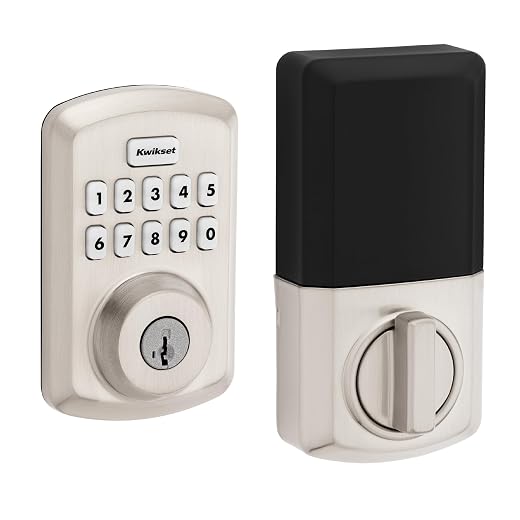
The Kwikset Powerbolt 250 10-Button Keypad Satin deadbolt strips away all wireless transmitters in favor of a self-contained, air-gapped electronic locking architecture. Engineered with an 18-piece installation assembly, this model is designed for utility-focused entry points like side doors, garage perimeter entrances, and storage workshops where remote network access is unnecessary. By eliminating RF circuitry entirely, the internal power regulator draws minimal resting current, yielding an operational battery lifespan of at least 12 months using four standard AA alkaline cells.
Access management is driven entirely through the physical 10-button interface. The onboard microcontroller accommodates up to 25 permanent user codes alongside 5 dedicated one-time user codes, which automatically self-delete immediately following a single successful unlock cycle. Administrative operations are secured via an isolated master programming code, preventing unauthorized credential additions directly at the door. If someone inputs three consecutive incorrect passcodes, the unit sounds an audible local intrusion alarm and enters a 60-second hardware lockout routine that ignores further keypad presses.
Mechanical reliability remains anchored by Kwikset’s SmartKey Security cylinder. This KW1 keyway mechanism protects against common mechanical bypass techniques while allowing property managers to re-key the physical lock cylinder in seconds using the included reset tool. With integrated auto-lock intervals programmable for 30 seconds, 1 minute, 3 minutes, 5 minutes, or 10 minutes, plus a dedicated Vacation Mode that suspends all digital keypad inputs, the Powerbolt 250 serves as a pragmatic entry point before users step up to higher-capacity SmartCode or connected hardware.
- Completely offline electronic deadbolt architecture immune to wireless signal interference
- Credential memory supporting 25 user codes, 5 single-use codes, and 1 programming code
- Automated multi-interval locking profiles from 30 seconds up to 10 minutes
- SmartKey cylinder allowing rapid manual re-keying to existing KW1 house keys
Kwikset SmartCode 270 Keyless Entry Electronic

Price not listed
4.1 average from Amazon buyersMostly positive
Brand Kwikset ASIN B0CC6JFS4C
Best for: High-security standalone deadbolts with touchscreen interfaces
Pros
- BHMA Grade 2 certified
- 50 primary user codes
- Customizable auto-lock intervals
- BILT 3D guided install
Cons
- Lacks remote app control
- No smart home ecosystem links
Bridging the gap between basic keyless entry and heavy-duty residential hardware, the Kwikset SmartCode 270 Keyless Entry Electronic deadbolt introduces verified BHMA Grade 2 structural certification. Standardized Grade 2 testing indicates that the lock bolt and housing provide up to 2.5 times the mechanical strength, impact resistance, and cycle durability of baseline Grade 3 utility locks. This elevated physical resilience makes the SmartCode 270 an exceptional option for high-exposure perimeter doors where physical forced-entry resistance is a top priority.
Interaction is centered on a responsive capacitive illuminated touchpad that illuminates upon physical contact. The device supports an expanded memory bank of 50 customizable primary user codes, 10 one-time use codes, and an administrative programming code. This 50-credential ceiling makes it far more versatile for growing families, service personnel, and short-term maintenance contractors than entry-tier 25-code units. System installation is augmented via the 3D interactive BILT mobile application, guiding tool alignment and bolt throw adjustments through voice and visual cues with standard household screwdrivers.
Like its physical pushbutton counterparts, the SmartCode 270 manages localized security through tamper alarm thresholds and vacation lockout toggles. When Vacation Mode is engaged via master inputs, all electronic credentials become inactive, ensuring that only physical keys can operate the deadbolt cylinder until the mode is deactivated. Powered by four AA alkaline cells, the device balances high-torque bolt driving motors with an ultra-low standby draw, maintaining a dependable 12-month maintenance interval under normal domestic cycling.
- Certified BHMA Grade 2 performance delivering 2.5x greater strength than Grade 3 locksets
- Capacitive light-up touchpad memory storing 50 user codes and 10 single-use access pins
- BILT interactive 3D digital deployment instructions for error-free mechanical alignment
- Three-strike incorrect attempt perimeter alarm with one-minute full hardware lockout
Kwikset HomeConnect 620 Z-Wave Long Range

Price not listed
4.0 average from Amazon buyersMostly positive
Brand Kwikset ASIN B0DWGRYD6B
Best for: Smart homes running Ring Alarm or Z-Wave
Pros
- Z-Wave 700 Long Range
- High-tier S2 encryption
- 250 user code capacity
- Extensive 2-inch door compatibility
Cons
- Requires dedicated hub
- No native standalone app
The Kwikset HomeConnect 620 Z-Wave Long Range deadbolt is engineered explicitly for homeowners with dedicated smart home hubs and monitored alarm ecosystems like Ring Alarm and Samsung SmartThings. By opting for a specialized Z-Wave 700 series radio rather than Wi-Fi, the 620 offloads compute-heavy cloud processing to an external gateway. This architecture provides exceptional wireless signal range, robust wall penetration across large homes, and superior energy efficiency, yielding a full 12 months of operation on four AA batteries included in the package.
Security protocols on the HomeConnect 620 are among the strictest in the industry. It integrates S2 (Security 2) framework encryption, utilizing advanced elliptic-curve cryptography to prevent packet interception, replay attacks, and unauthorized local radio interference. Furthermore, SmartStart technology allows seamless pairing: installers scan the internal QR code using their hub’s companion app, and the deadbolt automatically negotiates its cryptographic keys and network parameters upon initial power-up without manual pairing sequences.
The hardware accommodates up to 250 programmable credentials managed via the paired smart hub interface or directly through the keypad using a master programming code. It features expansive structural door accommodation, handling door thicknesses from 1-3/8 inches up to a full 2 inches, alongside an adjustable latch backset covering 2-3/8 inches to 2-3/4 inches. The HomeConnect 620 provides auto-locking delays, a backlit push-button interface, and real-time mesh telemetry. It is the premier pick for unified system integration, stepping aside only for buyers who demand bridge-free Wi-Fi operation.
- Z-Wave 700 Long Range transceiver delivering expanded coverage to compatible hubs
- Hardware-level S2 encryption paired with SmartStart simplified QR provisioning
- High-volume memory managing up to 250 distinct user codes via smart ecosystem hubs
- Extended mechanical compatibility supporting thick doors measuring up to 2.0 inches
Kwikset Halo Wi-Fi Smart Lock
Buyer favourite4.7 or better on Amazon’s buyer average
Price not listed
4.9 average from Amazon buyersOverwhelmingly positive
Brand Kwikset ASIN B081FYNZ7N
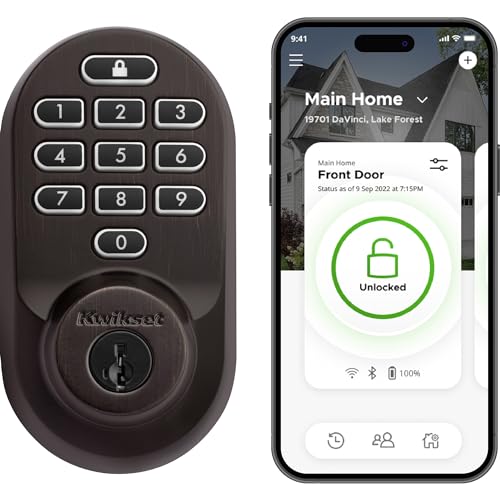
For users who desire the remote access convenience of native cloud connectivity but prefer the reliable tactile feedback of physical buttons, the keypad version of the Kwikset Halo Wi-Fi Smart Lock offers a compelling alternative. Mechanically identical in digital capacity to its touchscreen sibling, this deadbolt incorporates individual illuminated pushbuttons that provide a distinct tactile click upon depression. This mechanical input style is particularly advantageous in cold climates where gloved hands or exterior condensation can degrade capacitive touchscreen responsiveness.
Under the hood, an integrated Wi-Fi radio links directly to standard 2.4 GHz wireless networks, totally bypassing the need for supplementary bridges. Through the Kwikset application, system managers can monitor activity history logs in real time, review battery status, engage intelligent geofencing automations, and instantly distribute up to 250 access codes. These credentials can be restricted by calendar dates, specific times of day, or toggled on a temporary basis for guests, deliveries, or contractors.
Physical security is reinforced by an integrated SmartKey cylinder, allowing rapid mechanical re-keying while defending against bumping and picking attempts. Tamper logic triggers real-time smartphone alerts if excessive incorrect PIN codes are keyed into the backlit interface. Door dimension support spans 1-3/8 inches to 1-3/4 inches in thickness with an adjustable deadbolt backset between 2-1/8 inches and 2-3/4 inches. Covered by a lifetime mechanical/finish warranty and a 1-year electronics warranty, this deadbolt serves as the definitive bridge-free Wi-Fi option for traditional pushbutton enthusiasts.
- Integrated 2.4 GHz Wi-Fi radio enabling remote access without peripheral bridge units
- Durable tactile backlit keypad providing dependable operation in harsh ambient conditions
- Full 250-code memory profile supporting scheduled, temporary, and permanent guests
- Voice assistant integration supporting automation commands via Amazon Alexa and Google Home
Kwikset SmartCode 260 Keyless Entry Electronic

Price not listed
4.1 average from Amazon buyersMostly positive
Brand Kwikset ASIN B0BBJ3LTDF
Best for: Heavy-traffic exterior doors demanding Grade 2 durability
Pros
- BHMA Grade 2 rating
- Microban protected keypad
- 50 user codes capacity
- SmartKey re-key technology
Cons
- Zero wireless communication
- Physical buttons show wear
The Kwikset SmartCode 260 Keyless Entry Electronic deadbolt represents a rugged, push-button iteration of Kwikset’s certified Grade 2 standalone hardware lineup. In environments where high-touch surfaces gather dirt, grime, and bacteria, the SmartCode 260 distinguishes itself by incorporating Microban antimicrobial surface protection directly into the keypad material. This specialized additive actively inhibits bacterial growth on the buttons, keeping the high-frequency touch interface cleaner over extended periods of heavy residential usage.
Operating completely independent of wireless networks or local hubs, the unit guarantees zero exposure to digital network vulnerabilities. Its robust credential manager supports up to 50 user codes alongside 10 single-use access credentials and an administrative master programming code. Much like the broader kwikset door lock catalog, it utilizes a standard KW1 cylinder with SmartKey security, enabling rapid mechanical re-keying to match existing household entry hardware without replacing the deadbolt core.
Physical resistance is validated by its BHMA Grade 2 certification, delivering substantially higher structural bolt protection than entry-level Grade 3 locks against forced entry techniques. Installation requires only a standard screwdriver and is accelerated by step-by-step BILT 3D interactive digital instructions. With customizable auto-lock countdowns ranging between 30 seconds and 10 minutes, plus a 12-month expected battery duration powered by four AA cells, the SmartCode 260 is an outstanding option for homeowners seeking tactile durability and proven mechanical resistance without network complexities.
- BHMA Grade 2 certified physical deadbolt construction engineered for superior forced-entry defense
- Microban antimicrobial surface treatment integrated into the tactile push-button array
- Offline memory profile holding 50 primary user codes, 10 one-time pins, and 1 master code
- Includes complete SmartKey reset tool suite for immediate keyed cylinder re-matching
What Sets These Models Apart
Comparing Kwikset deadbolts across technical boundaries requires evaluating communication protocols, mechanical durability certifications, credential capacities, and physical input surfaces. The following table provides an analytical breakdown of these key engineering specifications across all six examined models:
| Product Name | Network Protocol | Security Certification | Credential Capacity | Input Interface |
|---|---|---|---|---|
| Kwikset Halo Wi-Fi Smart Lock (Touchscreen) | Direct Wi-Fi (2.4 GHz) | Grade AAA Certified | 250 User Codes | Capacitive Touchscreen |
| Kwikset Powerbolt 250 10-Button Keypad Satin | None (Offline Standalone) | Grade 3 Standard | 25 Codes + 5 One-Time | 10-Button Backlit Keypad |
| Kwikset SmartCode 270 Keyless Entry Electronic | None (Offline Standalone) | BHMA Grade 2 Certified | 50 Codes + 10 One-Time | Illuminated Touchpad |
| Kwikset HomeConnect 620 Z-Wave Long Range | Z-Wave 700 Long Range | Grade 2 Equivalent Housing | 250 User Codes | Backlit Push-Button Keypad |
| Kwikset Halo Wi-Fi Smart Lock (Keypad) | Direct Wi-Fi (2.4 GHz) | Grade AAA Certified | 250 User Codes | Tactile Backlit Pushbuttons |
| Kwikset SmartCode 260 Keyless Entry Electronic | None (Offline Standalone) | BHMA Grade 2 Certified | 50 Codes + 10 One-Time | Push-Button (Microban) |
The primary architectural divide among these deadbolts lies in wireless transceiver selection. While the Halo series relies on native Wi-Fi radios that process commands via cloud servers, the HomeConnect 620 utilizes sub-GHz Z-Wave signals that process locally through an on-premises hub. Conversely, the Powerbolt and SmartCode devices eliminate radio frequency hardware entirely. This structural trade-off yields significant battery life advantages for offline models while eliminating any vulnerability to network outages or remote interference.
Mechanical ratings also bifurcate the lineup. The SmartCode 260 and 270 models feature verified BHMA Grade 2 certifications, meaning their internal latches, strike plates, and physical housings are tested to endure substantially higher cyclical impacts and bolt pull forces than entry-tier hardware. Meanwhile, the Halo series carries Kwikset’s Grade AAA rating, demonstrating top-tier marks in residential mechanical security, cycle longevity, and finish durability. Choosing between them requires weighing network convenience against pure mechanical resistance and local control.
Buying Tips for Kwikset Smart Door Locks
When selecting among Kwikset keyless entry deadbolts, door preparation measurements must be verified before purchasing. Most standard American exterior residential doors have a thickness of 1-3/8 inches to 1-3/4 inches and a bore hole diameter of 2-1/8 inches. While models like the Halo and SmartCode precisely match this 1-3/4-inch upper threshold, homeowners with heavy custom entry doors should consider the HomeConnect 620, which natively accommodates doors up to 2.0 inches thick. Additionally, verify your backset measurement—the distance from the edge of the door to the center of the bore hole—ensuring the lock latch adjusts smoothly between the standard 2-3/8-inch and 2-3/4-inch configurations.
Power delivery and maintenance intervals represent another critical operational factor. Direct-to-Wi-Fi models like the Kwikset Halo continuously maintain or re-establish connections with home routers, resulting in regular battery replacement intervals compared to offline or Z-Wave locks. If you choose a Wi-Fi deadbolt, plan on utilizing premium AA alkaline cells and monitoring battery levels inside the companion app. Conversely, if your goal is an installation that operates for over 12 months without maintenance, standalone deadbolts like the SmartCode 260/270 or sub-GHz mesh models like the HomeConnect 620 provide vastly superior energy profiles.
Finally, carefully audit your credential requirements and user management workflows. If you manage a bustling home or rental property that requires time-fenced guest access or single-use delivery codes, prioritize units that provide dedicated temporary code partitions. While the Powerbolt 250 offers 5 single-use codes and the SmartCode models provide 10, the cloud-connected Halo and hub-managed HomeConnect 620 deliver up to 250 codes with scheduling logic. Evaluating the administrative burden of programming codes directly on a 10-button faceplate versus issuing them remotely through a smartphone app should dictate whether you invest in connected or offline hardware.