Pit Boss Smoker Pellets Technical Breakdown: Blend Specs & Fuel Efficiency
Selecting the right smoker pellets pit boss options requires a technical look at wood composition, compressed density, moisture tolerance, and operational burn efficiency across various smoker grills. Fuel performance dictates thermal stability and combustion cleanliness, meaning that the specific hardwood species and manufacturing consistency directly govern how often you clean ash deposits out of your…
As Amazon Associates, we earn from qualifying purchases. This means we may receive a small commission at no extra cost to you if you click through and make a purchase.
Selecting the right smoker pellets pit boss options requires a technical look at wood composition, compressed density, moisture tolerance, and operational burn efficiency across various smoker grills. Fuel performance dictates thermal stability and combustion cleanliness, meaning that the specific hardwood species and manufacturing consistency directly govern how often you clean ash deposits out of your fire pot. Pit boss smoker pellets rely on natural lignins under high compression to hold structural integrity rather than synthetic binders, allowing forced-air induction systems to generate uniform heat and continuous thin blue smoke without temperature surges.
This technical guide analyzes 3 specific offerings from the catalog: the standard 15-pound competition blend bag, a bulk 40-pound fuel package, and a portable tabletop grill engineered around a matched pellet delivery system. Each option addresses a distinct operational scale, separating compact trial sessions from bulk refueling needs and integrated hardware setups. By examining hardwood ratios, packaging volumes, and mechanical consumption demands, this pit boss smoker pellets comparison provides the exact specifications needed to optimize your outdoor cooking setup.
Which Pit Boss Smoker Pellets Should You Buy
- Backyard cooks looking for an all-purpose wood mixture for balanced flavor across poultry, pork, and beef should select the Pit Boss Competition Blend 100% All.
- High-volume pitmasters who run continuous low-and-slow cooks and need large fuel reserves will get the best utility from the JN Pit Boss Competition Blend BBQ.
- Outdoor enthusiasts, tailgaters, and campers who need a self-contained cooking platform designed around a dedicated fuel hopper should choose the Pit Boss 150 Wood Pellet Grill.
Pit Boss Competition Blend 100% All
Price not listed
Our score: 9.0/10Very positive
Brand PIT Boss ASIN B0GY1SB7FT
Best for: Everyday backyard smoking and balanced smoke profiles
Pros
- Four-hardwood blend
- Low ash production
- Zero chemical binders
Cons
- Smaller 15 lb capacity
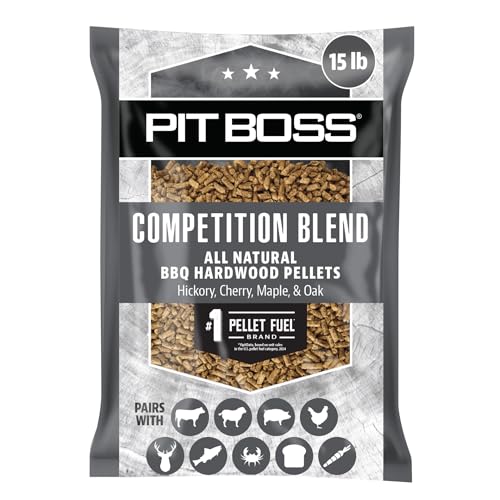
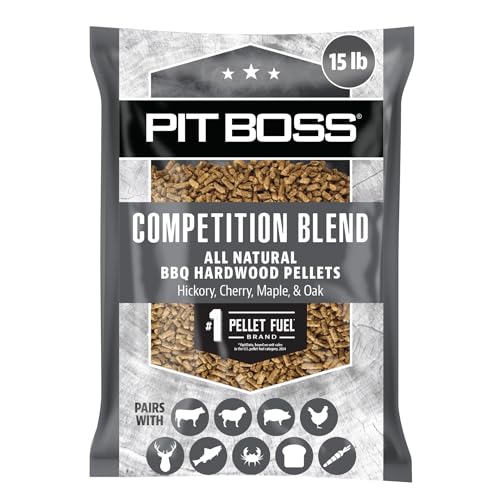
The Pit Boss Competition Blend 100% All serves as an all-around fuel platform engineered from premium North American hardwoods. This formula blends maple, hickory, cherry, and oak into a single extruded profile, giving outdoor cooks a balanced flavor spectrum suitable for everything from delicate poultry to heavy beef cuts. Manufactured under part number 55135096S, this 15-pound package emphasizes uniform cylinder extrusion to prevent auger bridging and ensure smooth transit through standard motor feeds.
Combustion characteristics depend heavily on wood purity, and these pit boss hardwood pellets contain zero percent artificial additives, glues, chemical binders, or synthetic aromas. The natural moisture level is kept low during manufacturing, which supports rapid ignition cycles, stable BTU heat output, and low ash residue inside the firebox. Minimizing fly ash is essential for convection airflow inside smokers, making this blend a reliable option for low-and-slow barbecue as well as high-temperature roasting. When fine-tuning internal cook temperatures alongside clean wood combustion, utilizing a reliable pit boss meat probe for smoker monitoring ensures your target doneness aligns with your smoke absorption phases.
This specific 15-pound package format is ideal for grillers who cook periodically or those who want to evaluate the multi-wood flavor profile without dedicating storage space to oversized sacks. However, users running extended 16-hour brisket or pork shoulder cooks may find that a single 15 lb bag runs out quickly during cold-weather smoking, making larger bulk configurations a more practical alternative for high-capacity smokers.
- Formulated with a four-wood ratio of maple, hickory, cherry, and oak
- Free from artificial binders, chemical additives, glues, and synthetic fillers
- Engineered with low moisture levels to minimize ash residue and wood dust
- Packaged in a convenient 15-pound single-bag unit for easy storage
JN Pit Boss Competition Blend BBQ

Price not listed
Our score: 8.2/10Mostly positive
Brand JN ASIN B08W8FRH1K
Best for: High-volume cooks needing bulk fuel reserves
Pros
- Generous 40 lb package
- Two-pack distribution
- Dense hardwood fuel
Cons
- Confusing listing text
The JN Pit Boss Competition Blend BBQ listing provides a high-volume fuel supply distributed under a 40-pound total allocation across a 2-pack configuration. In contrast to standard retail sacks, this multi-pack structure splits the bulk weight into manageable portions, protecting half of your fuel supply from environmental humidity while you burn through the first sack. Catalog technical data identifies the product under brand JN with a hickory scent and flavor emphasis, providing dense hardwood heat suitable for long cooks.
Prospective buyers reviewing this specific product entry should note a major catalog discrepancy: the manufacturer description field erroneously details automotive vinyl decal specifications instead of wood processing data. Despite this descriptive error, the listing attributes confirm two 20-pound containers totaling a 40-pound delivery of hardwood pellets. The dense wood fiber profile delivers high heat and steady smoldering when dialed into lower cooking zones. To maintain optimal hopper feed reliability and protect bulk fuel from moisture damage, pairing your setup with genuine pit boss accessories for pellet grill maintenance helps prevent internal hopper corrosion and auger binding.
This 40-pound volume configuration suits seasoned smoking enthusiasts who run frequent overnight sessions and cannot afford mid-cook hopper outages. Having 40 pounds on hand provides the reserve needed for sustained low-and-slow sessions where fuel consumption accumulates over dozens of hours. If you only operate a small portable grill on weekends, storing 40 pounds of compressed wood in humid environments requires dedicated airtight storage containers to prevent the pellets from absorbing ambient water vapor.
- Total 40-pound hardwood supply provided across a practical two-pack configuration
- Hickory flavor profile tailored for robust red meat and barbecue classics
- Substantial fuel reserve designed to support multi-day or continuous overnight cooks
- Extruded solid wood construction formulated for steady heat output
Pit Boss 150 Wood Pellet Grill

Buyer favouriteScored 9.4/10 or higher
Price not listed
Our score: 9.6/10Overwhelmingly positive
Brand PIT Boss ASIN B0D7DJHWDP
Best for: Tailgating and mobile wood-fired cooking
Pros
- Compact 7 lb hopper
- 1000°F flame broiler
- Digital temperature control
Cons
- Limited 256 sq in grate
The Pit Boss 150 Wood Pellet Grill pairs directly with hardwood pellet fuel to deliver an integrated, portable cooking ecosystem. Built for tailgating, job sites, and camping trips, this unit provides 256 square inches of porcelain-coated steel cooking area powered by a single heating element and an automated convection airflow system. Measuring 24.8 inches deep, 18.6 inches wide, and 14 inches high, this 43-pound smoker packs a fully operational digital temperature controller into a tabletop chassis with latching lid hardware.
Thermal control spans an operational operating band from 180 degrees Fahrenheit up to 500 degrees Fahrenheit, making it capable of smoking ribs or baking side dishes with ease. For high-heat finishing, the integrated flame broiler plate slides open to expose foods to direct flame cooking up to 1,000 degrees Fahrenheit. The onboard fuel hopper holds up to 7 pounds of hardwood pellets, providing enough capacity for complete meals without requiring external hopper extensions. When evaluating pellet consumption metrics against alternative fuel brands like bear mountain pellets, matching high-density wood fuel to this compact burn pot ensures clean combustion across all three digital power levels.
This compact grill suits outdoor cooks who need true wood-fired capability away from their home patio. The automatic startup and cooldown cycles simplify temperature management, while the locking lid keeps the porcelain grates and internal components secured during travel. It gives way to full-sized freestanding residential smokers when you need to cook multiple briskets or full racks of ribs simultaneously, as the 256-square-inch footprint is strictly scaled for compact portability.
- Integrated 7-pound hopper capacity sized for portable smoking and grilling
- Digital temperature control system regulating a 180°F to 500°F cooking range
- Direct-heat flame broiler slide plate delivering searing heat up to 1,000°F
- Porcelain-coated steel cooking grates offering 256 square inches of cooking space
What Sets These Models Apart
Understanding the mechanical differences between individual pellet packages and matching hardware clarifies which pit boss smoker pellets to buy for your particular setup. The following comparison table outlines the primary specifications across these three catalog options.
| Product Name | Category Type | Weight or Capacity | Primary Hardwood Profile |
|---|---|---|---|
| Pit Boss Competition Blend 100% All | Fuel Bag | 15 Pounds | Maple, Hickory, Cherry, and Oak |
| JN Pit Boss Competition Blend BBQ | Bulk Fuel Multi-Pack | 40 Pounds (2 Packs) | Hickory |
| Pit Boss 150 Wood Pellet Grill | Pellet Grill Appliance | 7 lb Hopper / 256 sq in | Compatible with Hardwood Pellets |
Buying Tips for Pit Boss Smoker Pellets
Managing the physical condition of wood pellets is the single most important factor in preventing auger jams and flameouts. Compressed hardwood pellets are naturally hygroscopic, meaning they absorb ambient moisture directly from the air. When moisture enters the pellet, the wood fibers expand, soften, and crumble into loose sawdust. This degraded dust will quickly pack inside the auger tube, binding the motor shaft and shutting down your cook. Always store leftover pellets in airtight plastic buckets with gasket-sealed lids rather than leaving them inside an open bag in a damp garage.
Understanding your pit boss pellet burn rate helps plan fuel purchases for long smoking sessions. At low-and-slow temperatures between 200°F and 250°F, standard pellet smokers consume roughly 1 to 1.5 pounds of fuel per hour under mild weather conditions. When operating at grilling temperatures above 400°F, consumption often increases to 2.5 to 3 pounds per hour. Wind, ambient winter temperatures, and thin cooker walls will accelerate this consumption rate, so maintaining adequate reserves ensures you never run the hopper dry mid-cook.
While pellet grills excel at balanced smoke delivery, outdoor chefs who prefer alternate fuel methods like a pit boss propane smoker often use wood chips or sawdust pans rather than compressed pellets. If you operate an electric or gas cabinet smoker alongside your pellet grill, you can use competition blend hardwood pellets inside aftermarket smoke generator tubes to introduce authentic wood-fired aroma without altering the primary gas burner system.