Orbi Mesh WiFi System Breakdown: Bandwidth, Backhaul, and Port Comparison
Selecting the right orbi mesh wifi system requires matching your residential floor plan, device density, and broadband speed tier against the appropriate internal radio architecture. Rather than relying on generic consumer ratings, an effective mesh deployment depends on analyzing radio frequency classes, inter-node backhaul configurations, and wired multi-gigabit port capabilities. WiFi 7 (802.11be) introduces substantial…

As Amazon Associates, we earn from qualifying purchases. This means we may receive a small commission at no extra cost to you if you click through and make a purchase.
Selecting the right orbi mesh wifi system requires matching your residential floor plan, device density, and broadband speed tier against the appropriate internal radio architecture. Rather than relying on generic consumer ratings, an effective mesh deployment depends on analyzing radio frequency classes, inter-node backhaul configurations, and wired multi-gigabit port capabilities. WiFi 7 (802.11be) introduces substantial improvements in spectral efficiency and data throughput, but realizing those gains depends on whether your nodes utilize shared dual-band spectrum or isolated transport channels.
This technical guide examines six specific hardware packages to deliver a comprehensive orbi mesh system comparison. The lineup spans entry dual-band systems across two-pack, three-pack, and four-pack configurations, high-throughput tri-band options with isolated backhaul lanes, and flagship quad-band platforms engineered with 10 Gbps Ethernet interfaces. By comparing the architectural capabilities, spatial stream ratings, and physical interfaces across each model, you can determine which orbi mesh system to buy for your specific infrastructure requirements.
Which Orbi Mesh WiFi System Should You Buy
- Properties up to 4,000 square feet: The NETGEAR Orbi 370 Series WiFi 7 (2-Pack) offers dual-band WiFi 7 coverage for up to 70 devices.
- Standard residences up to 6,000 square feet: The NETGEAR Orbi 370 Series WiFi 7 (3-Pack) delivers reliable multi-room coverage with 2.5 Gbps WAN support.
- Sprawling single-story layouts up to 8,000 square feet: The NETGEAR Orbi 370 Series WiFi 7 (4-Pack) distributes four nodes to bypass architectural obstacles.
- High-density homes up to 8,000 square feet: The NETGEAR Orbi 770 Series WiFi 7 (3-Pack) provides tri-band spectrum with a dedicated inter-node backhaul.
- Multi-gigabit households up to 9,000 square feet: The NETGEAR Orbi 870 Series WiFi 7 (3-Pack) combines 21 Gbps throughput, a 10G WAN port, and 12 multi-gig ports.
- Elite estates up to 10,000 square feet with 200 devices: The NETGEAR Orbi 970 Series (3-Pack) provides quad-band operation, 27 Gbps bandwidth, and dual 10G interfaces.
NETGEAR Orbi 370 Series WiFi 7

Buyer favouriteScored 9.4/10 or higher
Price not listed
Our score: 9.8/10Overwhelmingly positive
Brand Netgear ASIN B0FH39S1XJ
Best for: Townhomes and apartments wanting entry WiFi 7
Pros
- Covers up to 4,000 sq ft
- 5 Gbps Multi-Gig Ethernet ready
- Connects up to 70 devices
Cons
- Dual-band shared spectrum
- Single port listed on node

Best for: Sprawling single-story layouts requiring wide node distribution
Pros
- Four nodes cover 8,000 sq ft
- WiFi 7 speeds up to 5 Gbps
- Supports 2.5 Gbps broadband
Cons
- Dual-band shared backhaul
- Single port listed on node
Best for: Medium properties needing balanced WiFi 7 coverage
Pros
- Up to 6,000 sq ft coverage
- Supports up to 70 devices
- Multi-Gig Ethernet up to 2.5 Gbps
Cons
- Shared dual-band backhaul
- Modest 5 Gbps speed ceiling
The NETGEAR Orbi 370 Series WiFi 7 three-pack (model RBE373) serves as the baseline hardware configuration for 802.11be deployments. Engineered to blanket homes up to 6,000 square feet, this system pairs one RBE371 router with two RBE370 satellites to connect up to 70 client devices. Utilizing dual-band technology with Enhanced Backhaul, it achieves data transfer speeds up to 5 Gbps, which is 2.4X faster than WiFi 6. The router features Multi-Gig Ethernet compatible with fiber and cable ISP subscriptions up to 2.5 Gbps, protected out of the box by Advanced Router Protection and a 30-day trial of NETGEAR Armor.
This configuration suits suburban homeowners who want next-generation wireless speeds without the complex overhead or cost of enterprise-grade hardware. Compared to single-unit routers for wireless internet orbi setups, the distributed mesh units eliminate coverage dead zones across multi-level layouts and basements. Modular scalability allows adding optional satellites for up to 2,000 square feet of extra coverage per node. However, heavy local traffic or high-concurrency streaming will eventually saturate this shared dual-band architecture, where it concedes performance to the dedicated backhaul channels of the 770 series.
- Dual-band WiFi 7 delivering data rates up to 5 Gbps
- Covers up to 6,000 square feet for up to 70 concurrent devices
- Multi-Gig Ethernet interface compatible with broadband up to 2.5 Gbps
- Expandable via modular satellites adding 2,000 square feet each
NETGEAR Orbi 770 Series WiFi 7

Buyer favouriteScored 9.4/10 or higher
Price not listed
Our score: 9.8/10Overwhelmingly positive
Brand Netgear ASIN B0D4JB6QJD
Best for: Large households wanting dedicated tri-band backhaul
Pros
- Dedicated backhaul band
- Up to 11 Gbps speeds
- Seven 2.5 Gbps multi-gig ports
Cons
- Caps WAN input at 2.5 Gbps
The NETGEAR Orbi 770 Series WiFi 7 three-pack introduces true tri-band mesh networking designed to eliminate backhaul bottlenecking in busy households. Operating on proprietary Linux-based firmware, the system yields speeds up to 11 Gbps across footprints up to 8,000 square feet for up to 100 devices. The defining technical advantage is its Tri-Band technology with Enhanced Backhaul, dedicating a full wireless frequency band strictly to communication between the router and satellites so client device traffic never compromises node-to-node throughput.
This model is ideal for active households running concurrent 8K media streaming, online gaming, and extensive smart home automation. Across the router and satellites, the system provides seven total ports with 2500 Mbps (2.5 Gbps) LAN port bandwidth, accommodating wired switches, PCs, and gaming consoles. It readily handles incoming broadband tiers up to 2.5 Gbps; users routing connections from starlink for home setups can also leverage the multi-gigabit WAN port for clean distribution. The 770 series gives way to the 870 series when a residence requires 10 Gbps WAN switching or higher wired port density.
- Tri-band WiFi 7 yielding aggregate throughput up to 11 Gbps
- Dedicated backhaul band isolates inter-node transmission from client traffic
- Seven multi-gigabit ports featuring 2500 Mbps LAN bandwidth
- Covers up to 8,000 square feet and links up to 100 devices
NETGEAR Orbi 370 Series WiFi 7

Price not listed
Our score: 9.0/10Very positive
Brand Netgear ASIN B0FH392DTW
The four-pack edition of the NETGEAR Orbi 370 Series WiFi 7 is designed for large properties where distance and structural barriers create dead zones, rather than extreme client counts. Comprising one router and three satellites, this system blankets up to 8,000 square feet while supporting up to 70 devices. Operating on dual-band 802.11be WiFi 7, it achieves data transfer speeds up to 5 Gbps and includes Multi-Gig Ethernet capability engineered for internet connections up to 2.5 Gbps.
This hardware bundle suits sprawling single-story homes, ranches, or residences with thick plaster or masonry walls where placing four distributed nodes maintains consistent line-of-sight signal paths. Enhanced Backhaul manages wireless priorities across the dual-band spectrum to keep video conferences and 4K streams responsive. However, because the system relies on shared dual-band channels and the listing notes a single port configuration on the hardware, users needing multiple hardwired LAN drops per satellite or dedicated backhaul frequencies should choose the tri-band Orbi 770 instead.
- Four-pack mesh configuration blanketing structures up to 8,000 square feet
- Dual-band WiFi 7 performance reaching speeds up to 5 Gbps
- Multi-Gig Ethernet support compatible with plans up to 2.5 Gbps
- Connects up to 70 devices with WPA3 encryption and NETGEAR Genie OS
NETGEAR Orbi 970 Series
Buyer favouriteScored 9.4/10 or higher
Price not listed
Our score: 9.6/10Overwhelmingly positive
Brand Netgear ASIN B0H6XZRNVR
Best for: Estates requiring maximum multi-gig quad-band performance
Pros
- Quad-band with dedicated backhaul
- Extreme 27 Gbps aggregate speed
- 10 Gig WAN and LAN ports
- Covers up to 10,000 sq ft
Cons
- Overkill for standard broadband tiers
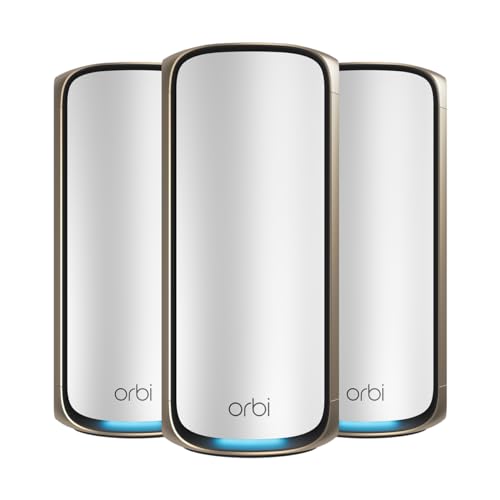
The NETGEAR Orbi 970 Series three-pack (2026 Release) is NETGEAR flagship wireless mesh platform, engineered for expansive luxury estates and heavy multi-gigabit traffic. Pushing wireless throughput up to 27 Gbps, this setup covers up to 10,000 square feet and supports up to 200 concurrent devices. The cornerstone of the 970 is its patented Quad-Band technology with Enhanced Dedicated Backhaul, which reserves a private wireless highway exclusively for node communication, leaving three client bands completely unencumbered.
Wired connectivity is configured for uncompromising performance. The system features a 10 Gig internet WAN port capable of handling 10 Gbps broadband tiers, along with 10 Gig and 2.5 Gig LAN ports across the router and satellites for multi-gigabit wired backhauls, network-attached storage, and workstation connections. While enthusiasts evaluating a dedicated nighthawk mesh wifi system may consider separate routers, the Orbi 970 provides unmatched whole-home quad-band switching. For properties with modest square footage or sub-gigabit connections, however, this flagship hardware represents significant overprovisioning.
- Patented quad-band architecture delivering throughput up to 27 Gbps
- 10 Gig internet port ready for multi-gigabit fiber plans up to 10 Gbps
- Ultra-fast 10 Gig and 2.5 Gig LAN ports across base router and satellites
- Blankets up to 10,000 square feet with support for 200 connected clients
NETGEAR Orbi 370 Series WiFi 7

The two-pack configuration of the NETGEAR Orbi 370 Series WiFi 7 offers an accessible path to 802.11be mesh networking for smaller homes and apartments. Consisting of one router and one satellite, this setup covers up to 4,000 square feet and links up to 70 devices on one network. Delivering speeds up to 5 Gbps—roughly 2.4X faster than WiFi 6—the system features Multi-Gig Ethernet connectivity ready for internet plans up to 2.5 Gbps, with setup and controls managed through the Orbi mobile application.
This package suits townhomes, apartments, and single-story houses where a standalone router leaves weak signals in rear rooms. Enhanced Backhaul manages dual-band frequency allocation to maintain reliable connections across gaming consoles, PCs, and security cameras. If property needs expand later, add-on satellites provide up to 2,000 square feet of additional reach. However, for homes larger than 4,000 square feet or environments requiring multiple physical LAN connections per satellite, this two-pack should yield to larger 370 bundles or the multi-port 770 series.
- Dual-band WiFi 7 coverage spanning up to 4,000 square feet
- Throughput speeds up to 5 Gbps supporting up to 70 devices
- Multi-Gig Ethernet port accommodating broadband services up to 2.5 Gbps
- WPA2-PSK and WPA3 security protocols managed via NETGEAR Genie
NETGEAR Orbi 870 Series WiFi 7

Price not listed
Our score: 8.6/10Mostly positive
Brand Netgear ASIN B0DPLH5DFH
Best for: High-bandwidth homes with 10 Gbps internet plans
Pros
- 10 Gig internet port
- 12 total multi-gig ports
- Up to 21 Gbps speeds
- Dedicated backhaul band
Cons
- Lacks fourth radio band of 970
The NETGEAR Orbi 870 Series WiFi 7 three-pack delivers an advanced balance of high-speed tri-band wireless and massive multi-gigabit switching. Operating on RouterOS firmware with fixed internal antennas, it delivers transfer speeds up to 21 Gbps across up to 9,000 square feet for up to 150 devices. The tri-band design dedicates an entire wireless frequency band to inter-node communication, ensuring that high-throughput satellite backhaul operates without interfering with endpoint connections.
Wired capabilities are top-tier, starting with a 10 Gig internet port ready for 10 Gbps fiber broadband and 2.5 Gig LAN ports across the nodes. With 12 total ports distributed across the system, the 870 provides extensive hardwired switching for home offices, media servers, and gaming rigs. For users needing external property coverage, indoor nodes can be paired with an orbi wifi outdoor extender to preserve performance across yards. The Orbi 870 represents the ultimate tri-band mesh solution, giving way only to the quad-band 970 series when a fourth radio band and 10G LAN switching are required.
- Tri-band WiFi 7 architecture outputting speeds up to 21 Gbps
- 10 Gig internet port compatible with broadband plans up to 10 Gbps
- 12 total multi-gigabit ports with 2.5 Gig LAN connectivity across nodes
- Covers up to 9,000 square feet with capacity for 150 concurrent devices
What Sets These Models Apart
| Model | Frequency Architecture | Data Transfer Rate | Coverage & Capacity | WAN & Port Specification |
|---|---|---|---|---|
| NETGEAR Orbi 370 Series (2-Pack) | Dual-Band | 5 Gbps | 4,000 sq ft / 70 devices | 2.5 Gbps WAN / 1 port listed |
| NETGEAR Orbi 370 Series (3-Pack) | Dual-Band | 5 Gbps | 6,000 sq ft / 70 devices | 2.5 Gbps WAN / Multi-Gig Ethernet |
| NETGEAR Orbi 370 Series (4-Pack) | Dual-Band | 5 Gbps | 8,000 sq ft / 70 devices | 2.5 Gbps WAN / 1 port listed |
| NETGEAR Orbi 770 Series (3-Pack) | Tri-Band | 11 Gbps | 8,000 sq ft / 100 devices | 2.5 Gbps WAN / 7 ports (2500 Mbps LAN) |
| NETGEAR Orbi 870 Series (3-Pack) | Tri-Band | 21 Gbps | 9,000 sq ft / 150 devices | 10 Gbps WAN / 12 ports (2.5G LAN) |
| NETGEAR Orbi 970 Series (3-Pack) | Quad-Band | 27 Gbps | 10,000 sq ft / 200 devices | 10 Gbps WAN / 10G & 2.5G LAN ports |
Buying Tips for Orbi Mesh WiFi Systems
When evaluating the netgear orbi wifi 7 lineup, your primary technical decision revolves around radio architecture and backhaul management. Understanding tri-band vs quad-band orbi setups is vital for high-density environments. The dual-band netgear orbi 370 series shares wireless spectrum between connected clients and inter-node backhaul, making it optimal for basic multi-room coverage. In contrast, the netgear orbi 770 series and netgear orbi 870 series isolate node traffic onto a dedicated third frequency band, preventing speed drop-offs during intensive local network usage.
Broadband provisioning should dictate your physical port requirements. While the 370 and 770 platforms support connections up to 2.5 Gbps, multi-gigabit fiber subscriptions reaching 5 Gbps or 10 Gbps require an orbi 10gbe mesh router. Both the 870 series and the flagship netgear orbi 970 series feature 10 Gig internet ports to eliminate ISP bottlenecks, alongside 2.5G and 10G LAN ports to support high-throughput network-attached storage and workstation switching across satellites.
Finally, factor in home layout and architectural materials rather than nominal square footage figures alone. Solid masonry, metal studs, and floor concrete attenuate RF signals significantly. In sprawling layouts, choosing a four-pack or adding modular satellites maintains clean line-of-sight communication between nodes. Conducting an accurate orbi mesh system comparison ensures you determine which orbi mesh system to buy based on real-world node placement, port count, and client device capacity.