Orbi Outdoor WiFi Extenders Compared: Hardware Specs, Backhaul, and Range
Deploying an effective orbi wifi outdoor extender setup requires choosing between dedicated exterior physical enclosures and high-throughput indoor mesh nodes engineered to punch signals through external exterior building materials. When extending connectivity to outdoor patios, perimeter security arrays, or detached garages, signal integrity degrades rapidly across siding, brickwork, and low-emissivity glass. Determining the right hardware…

As Amazon Associates, we earn from qualifying purchases. This means we may receive a small commission at no extra cost to you if you click through and make a purchase.
Deploying an effective orbi wifi outdoor extender setup requires choosing between dedicated exterior physical enclosures and high-throughput indoor mesh nodes engineered to punch signals through external exterior building materials. When extending connectivity to outdoor patios, perimeter security arrays, or detached garages, signal integrity degrades rapidly across siding, brickwork, and low-emissivity glass. Determining the right hardware configuration hinges on your primary network generation, available backhaul paths, and specific outdoor device requirements.
This technical comparison evaluates 5 distinct network solutions from the brand, covering legacy dedicated exterior hardware alongside current WiFi 7 whole-home systems and legacy modular extenders. By analyzing wireless communication standards, backhaul topologies, spatial stream capabilities, and deployment form factors, this guide details which hardware profile maintains reliable outdoor transmission speeds for your layout.
Which Orbi WiFi Extenders Should You Buy
- Direct all-weather patio mounting on older AC networks: NETGEAR Orbi Outdoor Satellite
- Maximum multi-gigabit throughput across massive yards on WiFi 7: NETGEAR Orbi 770 Series WiFi 7
- Full multi-node WiFi 7 coverage across suburban homes and perimeters: NETGEAR Orbi 370 Series WiFi 7
- Targeted perimeter expansion for existing RBE370 series mesh deployments: NETGEAR Orbi 370 Series WiFi 7
- Direct wall-outlet perimeter coverage for legacy AC indoor locations: NETGEAR Orbi Wall-Plug Whole Home Mesh
NETGEAR Orbi Outdoor Satellite

Price not listed
4.4 average from Amazon buyersVery positive
Brand Netgear ASIN B07864V14Q
Best for: Patio placement on legacy AC networks
Pros
- Weather-resistant exterior enclosure
- FastLane3 dedicated backhaul
- Adds 2,500 square feet coverage
Cons
- Incompatible with WiFi 6 or 7
- Discontinued manufacturer status
The NETGEAR Orbi Outdoor Satellite represents a specialized physical approach to perimeter wireless networking. Engineered with an exterior-rated enclosure, this weather-resistant satellite delivers up to 2,500 square feet of extended coverage directly within exposed outdoor environments. It eliminates the transmission attenuation inherent when broadcasting through double-pane glass or concrete foundations. Integrating the unit into an existing setup avoids running complex exterior cabling, while providing dedicated environmental resistance against rain, dust, and temperature fluctuations.
Internally, the hardware utilizes a tri-band frequency configuration capable of a 3 gigabits per second data transfer rate. Netgear deploys patented FastLane3 technology to establish a high-throughput connection back to the primary router, preserving bandwidth for client communication on the access bands. Network technicians should note hardware compatibility parameters: this satellite functions exclusively with first-generation Orbi Home and Orbi Pro systems, and the listing explicitly notes it is not compatible with Orbi WiFi 6 systems. Security protocols utilize WPA2, and administrative configuration occurs through the mobile application with WPS hardware push-button pairing support.
This hardware is optimal for property owners operating legacy AC mesh infrastructure who require true outdoor weatherproofing for pool terraces or barns. However, if your premises operate on newer 802.11ax or 802.11be hardware, this satellite will not establish a link. In scenarios where you need continuous exterior video transmission, comparing this configuration against a standalone unifi outdoor access point clarifies the mechanical differences between enterprise-grade PoE units and proprietary mesh nodes.
- Weather-resistant physical chassis designed for outdoor perimeter placement
- FastLane3 tri-band wireless architecture with up to 3 Gbps aggregate data transfer rate
- Coverage footprint extending up to 2,500 square feet per node
- Single physical network port with WPA2 security encryption
NETGEAR Orbi 770 Series WiFi 7

Buyer favourite4.7 or better on Amazon’s buyer average
Price not listed
4.9 average from Amazon buyersOverwhelmingly positive
Brand Netgear ASIN B0D4JB6QJD
Best for: Maximum multi-gigabit outdoor penetration
Pros
- Next-gen WiFi 7 up to 11 Gbps
- Covers up to 8,000 square feet
- Seven ports with 2500 Mbps LAN
Cons
- Indoor nodes require perimeter window placement
The NETGEAR Orbi 770 Series WiFi 7 takes a high-powered indoor transmission approach to solve exterior dead zones. Rather than relying on exterior-mounted nodes, this 3-pack mesh deployment creates a wireless envelope of up to 8,000 square feet that penetrates exterior walls to blanket patios, driveways, and backyards. Supporting the latest 802.11be specification, the platform delivers transmission rates up to 11 Gbps. This provides 2.4 times the speed capability of WiFi 6 hardware to handle 8K video streaming, virtual reality hardware, and intensive multi-device local traffic.
The system incorporates a tri-band architecture with Enhanced Backhaul, keeping inter-node transmission isolated from edge client traffic across up to 100 simultaneous devices. For hardwired operations, the system includes 7 network ports with multi-gigabit Ethernet capabilities rated up to 2500 Mbps. This multi-gigabit pipeline ensures that connections from high-speed fiber or cable internet service providers face zero interface bottlenecks. Network administration relies on Linux-based proprietary firmware managed via the mobile application, featuring modern WPA3 encryption, integrated IoT network separation, parental controls, VPN support, and Advanced Router Protection.
For expansive properties where exterior wall materials allow RF penetration, placing a satellite near a window or patio door provides substantial outdoor coverage without exposing sensitive electronics to weather extremes. This design suits modern smart homes with dense device arrays, including high-bitrate cameras. Those planning smart security architectures can observe how robust wireless networks maintain low-latency connections for hardware like a reolink wifi camera outdoor deployment across exterior perimeters.
- Next-generation 802.11be WiFi 7 tri-band operation delivering speeds up to 11 Gbps
- Enhanced Backhaul routing supporting up to 100 concurrent devices across 8,000 square feet
- Seven total physical interfaces featuring 2500 Mbps LAN port bandwidth
- WPA3 encryption paired with out-of-the-box Advanced Router Protection
NETGEAR Orbi 370 Series WiFi 7

Buyer favourite4.7 or better on Amazon’s buyer average
Price not listed
4.9 average from Amazon buyersOverwhelmingly positive
Brand Netgear ASIN B0FH39S1XJ
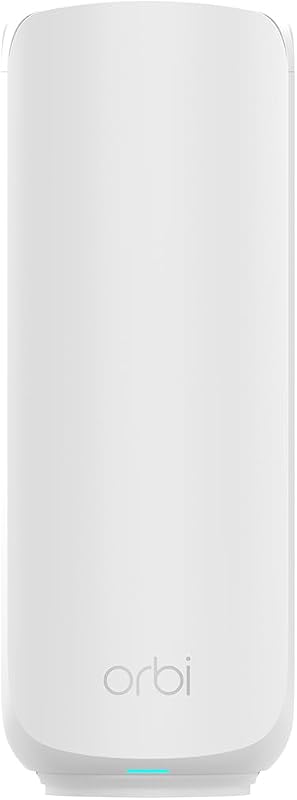
Best for: Targeted yard coverage for 370 owners
Pros
- Adds 2,000 square feet coverage
- 2500 Mbps multi-gigabit LAN port
- Unified single network SSID
Cons
- Restricted to 370 series systems only
Best for: Whole-home and perimeter WiFi 7 upgrades
Pros
- WiFi 7 speeds up to 5 Gbps
- Covers up to 6,000 square feet
- Includes Multi-Gig Ethernet capability
Cons
- Dual-band design lacks dedicated third band
The NETGEAR Orbi 370 Series WiFi 7 three-pack system (model RBE373) introduces next-generation wireless networking for mid-to-large residential structures requiring dependable perimeter coverage. This package includes one RBE371 router and two RBE370 satellites, establishing a comprehensive mesh fabric spanning up to 6,000 square feet. Engineered to support up to 70 concurrent devices, this hardware utilizes the 802.11be protocol to reach aggregate speeds up to 5 Gbps across connected clients, ensuring high efficiency for video calls, gaming consoles, and streaming appliances.
Unlike the larger tri-band systems, the RBE373 architecture operates on a dual-band frequency structure that leverages Enhanced Backhaul protocols to maintain synchronized throughput between the base station and satellite modules. Physical interfaces include Multi-Gig Ethernet capability, allowing wired backhaul configurations or high-speed connectivity to stationary network hardware like personal computers and security arrays. Internal antenna design optimizes spatial distribution, directing signal paths through standard residential siding to cover adjacent outdoor decks and entertainment areas.
This complete multi-node bundle matches households upgrading from older dual-band systems that suffer from connection dropouts near exterior walls. By positioning one of the included RBE370 nodes near the perimeter boundary of your home, outdoor WiFi coverage extends into lawn spaces. While it offers a lower maximum PHY rate than the 770 series, its dual-band WiFi 7 foundation provides significant multi-client scheduling advantages over previous-generation standards.
- Dual-band 802.11be system delivering aggregate data rates up to 5 Gbps
- Complete 3-pack hardware bundle covering up to 6,000 square feet for 70 devices
- Multi-Gigabit Ethernet connectivity for high-throughput wired transmission
- Seamless roaming capabilities unified under a single network identifier
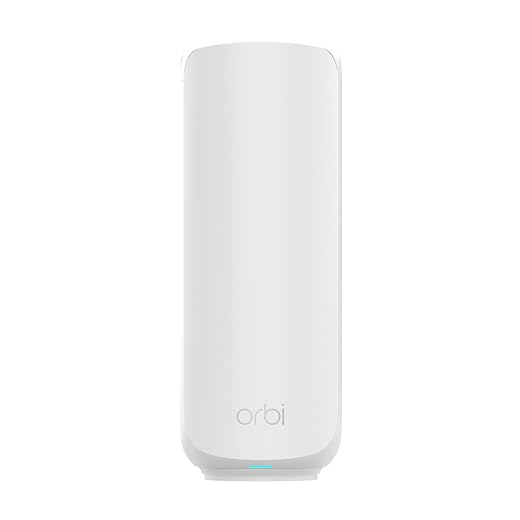
NETGEAR Orbi 370 Series WiFi 7
Price not listed
4.5 average from Amazon buyersVery positive
Brand Netgear ASIN B0FH3B57VT
For users who already operate an RBE370-series network, the standalone NETGEAR Orbi 370 Series WiFi 7 add-on satellite provides targeted expansion without purchasing unnecessary router units. Engineered specifically to integrate with RBE371, RBE372, and RBE373 base setups, this modular unit extends network reach by up to 2,000 square feet. It maintains uniform wireless network naming and roaming protocols, allowing mobile devices to transition between indoor living areas and exterior backyards without dropping active data sessions.
The satellite features dual-band WiFi 7 hardware delivering transmission speeds up to 5 Gbps. Enhanced Backhaul coordination ensures traffic passing between the satellite and primary router avoids legacy half-duplex speed penalties. For auxiliary hardware, the satellite incorporates 1 physical port with a 2500 Mbps LAN port bandwidth rating. This multi-gigabit interface enables users to establish a high-speed wired connection directly to an outbuilding, garage workspace, or exterior switch, bridging indoor mesh convenience with hardwired stability.
This add-on satellite represents a precise solution for curing specific exterior dead zones, such as a detached patio or garage. Instead of reconfiguring the primary network, users can position this satellite at the home interior edge closest to the target outdoor zone. The listing notes this hardware is made for use in the US only. If your outdoor layout requires alternative point-to-point hardware extensions, comparing these topologies against a modular linksys wifi range installation highlights the functional differences between proprietary mesh satellites and standalone range repeaters.
- Standalone add-on satellite designed specifically for RBE371, RBE372, and RBE373 systems
- Adds up to 2,000 square feet of WiFi 7 coverage on a unified network SSID
- Equipped with a 2500 Mbps multi-gigabit LAN Ethernet interface
- Dual-band radio architecture with Enhanced Backhaul reaching up to 5 Gbps
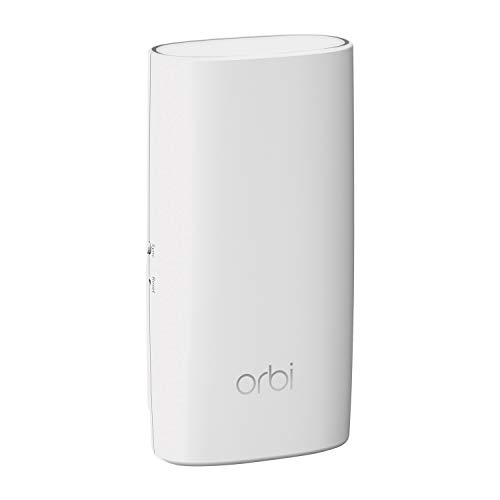
NETGEAR Orbi Wall-Plug Whole Home Mesh
Price not listed
4.1 average from Amazon buyersMostly positive
Brand Netgear ASIN B06XKC6V2X
Best for: Outlet-mounted indoor perimeter extension
Pros
- Compact direct wall-plug design
- Tri-band architecture with dedicated backhaul
- Adds 1,500 square feet coverage
Cons
- Only works with legacy AC routers
- Lacks exterior weatherproofing
The NETGEAR Orbi Wall-Plug Whole Home Mesh satellite (model RBW30) provides a low-profile alternative for expanding wireless boundaries without consuming tabletop surface area. Operating on an integrated plug-in form factor, this unit inserts directly into standard residential electrical wall outlets. It expands an existing mesh perimeter by up to 1,500 square feet, making it an efficient choice for sunrooms, hallways adjacent to rear decks, or mudrooms leading out to the yard.
Under the 802.11ac wireless standard, the RBW30 utilizes a tri-band frequency class to achieve maximum data transfer rates up to 2.15 Gbps (rated AC2200). A primary advantage of its tri-band design is the dedicated wireless backhaul, which manages communication between the wall plug and the central router without degrading bandwidth on client access channels. Security encryption is handled via standard WPA2 protocols, and hardware setup supports rapid synchronization via WPS button pairing.
Compatibility remains strictly constrained to first-generation AC-based mesh routers; the listing states it works exclusively with an existing Orbi Whole Home Mesh WiFi Router, with peak efficiency noted when paired with the RBK33 system. It cannot pair with newer WiFi 6 or WiFi 7 base systems. For households retaining functional AC-generation infrastructure, the RBW30 delivers simple placement to push signals through exterior walls toward outdoor sitting areas, though users needing weatherproofing must keep the unit indoors.
- Compact wall-plug chassis designed for direct AC outlet integration
- Tri-band 802.11ac architecture with dedicated backhaul delivering up to 2.2 Gbps
- Adds 1,500 square feet of extended coverage to supported mesh systems
- WPA2 security architecture featuring push-button WPS synchronization
What Sets These Models Apart
Network architects and home network planners must weigh distinct trade-offs across these hardware options. The primary distinctions lie in wireless generational protocols, internal backhaul allocation, physical chassis deployment, and generational compatibility barriers.
| Model | Wireless Standard | Frequency Architecture | Max Transfer Rate | Coverage Added |
|---|---|---|---|---|
| NETGEAR Orbi Outdoor Satellite | 802.11ac / 802.11ax listed | Tri-Band | 3 Gbps | Up to 2,500 sq ft |
| NETGEAR Orbi 770 Series WiFi 7 | 802.11be (WiFi 7) | Tri-Band | 11 Gbps | Up to 8,000 sq ft (3-pack) |
| NETGEAR Orbi 370 Series WiFi 7 | 802.11be (WiFi 7) | Dual-Band | 5 Gbps | Up to 6,000 sq ft (3-pack) |
| NETGEAR Orbi 370 Series WiFi 7 Satellite | 802.11be (WiFi 7) | Dual-Band | 5 Gbps | Up to 2,000 sq ft |
| NETGEAR Orbi Wall-Plug Whole Home Mesh | 802.11ac (WiFi 5) | Tri-Band | 2.15 Gbps | Up to 1,500 sq ft |
Hardware compatibility creates absolute deployment boundaries across these options. Modern WiFi 7 systems like the 770 and 370 series operate on entirely distinct protocol stacks, higher-order QAM modulation, and updated security handshakes compared to legacy AC-generation devices. Legacy satellites such as the RBW30 and the Outdoor Satellite cannot be introduced as expansion nodes into a 770 or 370 network, nor can modern 802.11be satellites synchronize with older AC routers.
Buying Tips for Orbi WiFi Extenders
When selecting hardware to extend network access across exterior spaces, the first operational checkpoint is verifying base router generation. Orbi hardware is strictly segregated by generation: 802.11ac hardware only functions with compatible legacy systems, and modern 802.11be satellites operate exclusively within their designated series. Attempting to mix an add-on satellite across generational boundaries will prevent node synchronization. Always match the exact series model numbers before acquiring individual satellite units.
Physical placement relative to building construction materials directly dictates outdoor signal strength. If you deploy an indoor satellite to project coverage into a yard, position the hardware directly against an exterior wall or inside a window frame overlooking the outdoor zone. Building envelopes with foil-faced insulation, low-E glass coatings, metal lath stucco, or dense brickwork severely attenuate 5 GHz and 6 GHz radio waves. Placing an indoor node adjacent to clear window glazing provides the cleanest RF propagation path to exterior patios.
Consider the interface requirements of stationary outdoor hardware. If you are servicing outdoor streaming consoles, garden workstations, or security bridges, selecting satellites equipped with multi-gigabit LAN ports allows you to run shielded exterior-grade Ethernet cables from the satellite directly to client hardware. Both the 770 and 370 series satellites provide 2500 Mbps ports, delivering a low-latency physical link that bypasses wireless transmission loss entirely.