Westinghouse 12500 Watt Generator Breakdown: Specs, Outlets, and Fuel Comparison
Selecting an emergency generator requires evaluating continuous output wattage, surge headrooms, and receptacle configurations against your electrical panel demands. When sizing a unit around the popular 12,500-watt threshold, homeowners frequently assess whether a dual-fuel open-frame generator like the WGen9500DF delivers enough stable electricity to manage an entire residence via a transfer switch. A machine providing…
As Amazon Associates, we earn from qualifying purchases. This means we may receive a small commission at no extra cost to you if you click through and make a purchase.
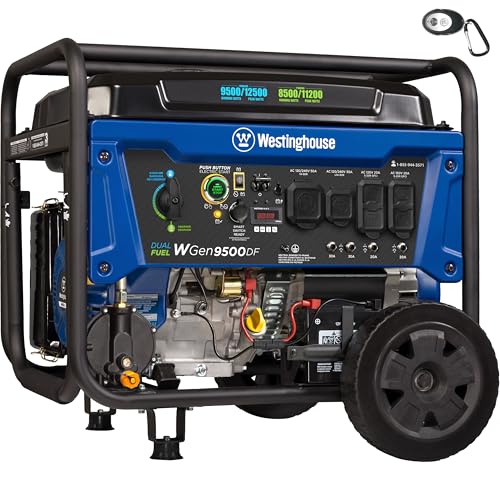
Selecting an emergency generator requires evaluating continuous output wattage, surge headrooms, and receptacle configurations against your electrical panel demands. When sizing a unit around the popular 12,500-watt threshold, homeowners frequently assess whether a dual-fuel open-frame generator like the WGen9500DF delivers enough stable electricity to manage an entire residence via a transfer switch. A machine providing 12,500 peak watts and 9,500 running watts supplies 39.5 continuous amps at 240 volts, which is generally sufficient to energize essential 120-volt household lines, well pumps, and central air-conditioning systems equipped with soft starters. However, operational trade-offs such as fuel availability during extended emergencies, acoustic volume, and total harmonic distortion must be factored in before committing to an installation.
This technical breakdown examines five portable power stations from Westinghouse to determine where each tier excels. The selection spans heavy-duty open-frame dual-fuel and tri-fuel machines engineered for full-panel connection down to lightweight inverter units designed for clean, quiet recreational operation. By comparing engine displacements from 80cc up to 550cc, runtimes across varied tank capacities, and integrated safety systems like carbon monoxide detection, this guide details how output wattage shifts across gasoline, liquid propane, and natural gas lines so you can choose the optimal power plant for your operational requirements.
Which Westinghouse Generators Should You Buy
- For whole-home transfer switch connection needing dual-fuel redundancy: Westinghouse 12500 Watt Dual Fuel Home.
- For severe multi-day blackouts requiring maximum gasoline wattage and extended fuel autonomy: Westinghouse 13500 Peak Watt Dual Fuel.
- For continuous domestic utility backup without fuel storage limits via natural gas lines: Westinghouse 14500 Peak Watt Tri-Fuel Home.
- For recreational vehicles, mobile jobsites, and sensitive sound-restricted camping: Westinghouse 2550 Peak Watt Super Quiet.
- For lightweight emergency essentials, field electronics charging, and ultra-compact transport: Westinghouse 1500 Peak Watt Super Quiet.
Westinghouse 12500 Watt Dual Fuel Home
Buyer favourite4.7 or better on Amazon’s buyer average
Price not listed
4.7 average from Amazon buyersOverwhelmingly positive
Brand Westinghouse ASIN B07Q1DLKBG
Best for: Whole-home emergency transfer switch backup
Pros
- 9500 running watts gas
- 50A and 30A receptacles
- Remote start key fob
Cons
- Standard harmonic distortion profile
- Heavy open-frame construction
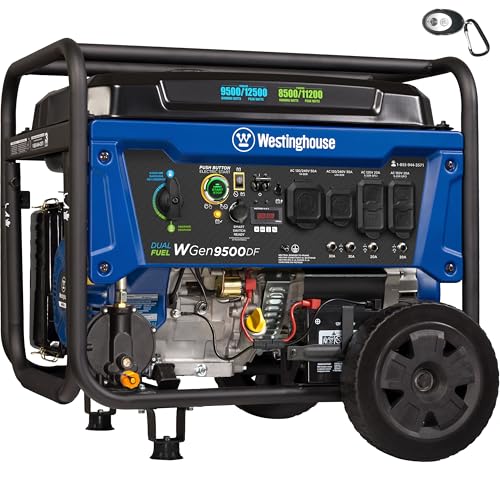
The Westinghouse 12500 Watt Dual Fuel Home serves as a baseline standard for residential transfer switch installations. Driven by a 457cc 4-stroke OHV engine built with a cast iron sleeve, this generator produces 12,500 peak watts and 9,500 running watts on gasoline, shifting to 11,200 peak watts and 8,500 running watts on liquid propane. The control face includes a 120V transfer switch ready L14-30R 30-amp twist-lock outlet alongside an RV-ready 120/240V 14-50R 50-amp port, granting direct split-phase utility for interlock panels. For those conducting a duromax 15000 watt generator evaluation to assess panel compatibility, this unit delivers ample amperage to run primary residential circuits without requiring dedicated industrial commercial gear.
Operational monitoring on the machine is handled via the VFT digital data meter, which toggles real-time metrics for operating voltage, alternating frequency, and lifetime cumulative run hours to streamline scheduled oil and spark plug service. The 6.6-gallon fuel cell provides up to 12 hours of run time under standard cycling. Ignition options include a push-button electric start, an auxiliary manual recoil backup, and a remote key fob that enables startup from inside the home. The unit features rubber safety covers across its six total power outlets, dual GFCI 5-20R standard duplex receptacles, and an automatic low-oil shutdown mechanism to safeguard the crankcase.
- Dual-fuel output yielding 9,500 running watts on gasoline and 8,500 running watts on propane
- Equipped with both a 30A L14-30R twist-lock and a 50A 14-50R split-phase receptacle
- Cast-iron sleeved 457cc OHV engine with an automatic low-oil shutdown system
- Comprehensive VFT digital readout displaying voltage, output frequency, and runtime hours
Westinghouse 13500 Peak Watt Dual Fuel

Buyer favourite4.7 or better on Amazon’s buyer average
Price not listed
4.8 average from Amazon buyersOverwhelmingly positive
Brand Westinghouse ASIN B0DXX3D6WC
Best for: Extended outages requiring high dual-fuel power
Pros
- 10500 running watts gas
- Automated CO sensor shutdown
- 19-hour fuel tank endurance
Cons
- Large 9.5-gallon fuel tank footprint
- Higher oil maintenance requirements
Stepping up in displacement, the Westinghouse 13500 Peak Watt Dual Fuel incorporates a 500cc 4-stroke OHV engine to support larger inductive motor startup surges. This generator produces 13,500 peak watts and 10,500 running watts when fueled by gasoline, and 12,500 peak watts with 9,500 running watts when running on liquid propane. That supplementary kilowatt of running overhead provides extra stability when cycling heavy loads such as dual sump pumps, central air blowers, and well water systems simultaneously. It also integrates an internal carbon monoxide detection sensor that instantly shuts down combustion if ambient exhaust gas accumulates to dangerous concentrations.
Fuel storage on this model expands to a 9.5-gallon steel fuel cell, extending operational endurance up to 19 hours on a single gasoline fill. Like the smaller dual-fuel platform, it provides both electric push-button ignition and remote key fob activation, supplemented by an emergency recoil pull cord. The outlet configuration utilizes four total power ports, retaining the heavy-duty 50-amp 14-50R and 30-amp L14-30R connections alongside GFCI-protected household outlets and an integrated USB charging port. While the 500cc engine demands diligent maintenance of its lubrication reservoir, the unit offers higher sustained wattage margins for substantial residential backup needs.
- High-output 500cc OHV engine supplying 10,500 running watts on gasoline and 9,500 running watts on propane
- Large 9.5-gallon fuel reservoir delivering up to 19 hours of runtime
- Integrated CO sensor offering automated shutdown protection against toxic gas buildup
- Panel layout with heavy-duty 50A and 30A ports alongside a convenience USB connection
Westinghouse 14500 Peak Watt Tri-Fuel Home

Buyer favourite4.7 or better on Amazon’s buyer average
Price not listed
4.8 average from Amazon buyersOverwhelmingly positive
Brand Westinghouse ASIN B0CLH9RBYD
Best for: Homes connected to natural gas utility lines
Pros
- Tri-fuel gas propane natural gas
- Clean power under 5 percent THD
- 11500 continuous running watts
Cons
- Substantial overall weight
- Two main distribution outlet groups
The Westinghouse 14500 Peak Watt Tri-Fuel Home expands operational utility by incorporating natural gas functionality alongside gasoline and propane systems. Engineered around a heavy-duty 550cc 4-stroke OHV engine, it delivers 14,500 peak watts and 11,500 running watts on gasoline, 13,500 peak watts and 10,500 running watts on propane, and 12,000 peak watts with 9,500 running watts when plumbed straight into a residential natural gas line. Connecting to an exterior utility gas line eliminates the need to store, treat, and rotate liquid fuels during multi-week utility outages. Despite its high displacement, the generator is built with durable copper windings and optimized to run at less than 5% total harmonic distortion, keeping waveform distortion within safe limits for delicate electronics.
Runtime reaches up to 19 hours on its 9.5-gallon (36-liter) fuel tank using gasoline, or up to 7 hours of operation when drawing from a standard 20-pound propane cylinder. The front panel layout is streamlined to focus strictly on essential power delivery, providing two primary distribution outlet hubs fitted with circuit breakers, automated voltage regulation, and an acoustic muffler to tame exhaust notes. Homeowners comparing equipment against high-output inverter alternatives like a champion dual fuel inverter generator will find this tri-fuel platform delivers higher raw wattage capacity across multiple fuel sources to power whole-home circuits effortlessly.
- Tri-fuel capability supporting gasoline, liquefied petroleum gas, and residential natural gas lines
- Massive 550cc cast-iron sleeved engine providing up to 11,500 continuous running watts
- Engineered with copper windings to maintain clean power delivery under 5% total harmonic distortion
- Automated carbon monoxide shutoff sensor combined with automatic voltage regulation
Westinghouse 2550 Peak Watt Super Quiet
Price not listed
4.3 average from Amazon buyersMostly positive
Brand Westinghouse ASIN B0C1PPYTLW
Best for: RV camping and sensitive microelectronics
Pros
- Quiet 52 dBA noise rating
- Under 3 percent THD power
- Dedicated TT-30R RV outlet
Cons
- 1900 running watts limit
- Manual recoil start only
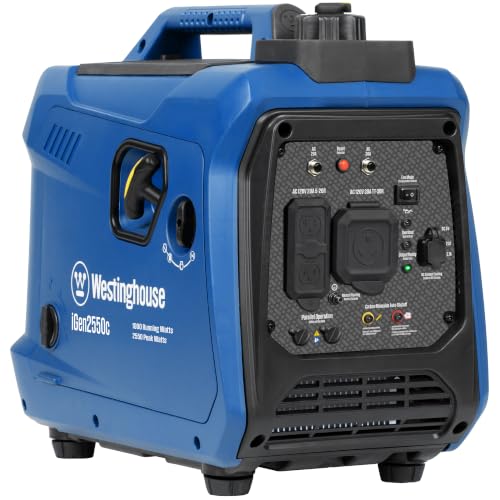
Shifting away from large, open-frame emergency plants, the Westinghouse 2550 Peak Watt Super Quiet is an enclosed inverter designed for quiet operation and high fuel efficiency. Powered by an 80cc 4-stroke OHV gasoline engine, this unit delivers 2,550 peak watts and 1,900 running watts. Utilizing computer-controlled digital inverter architecture, the total harmonic distortion is kept at or below 3%, making it suitable for powering sensitive equipment such as high-end audio setups, personal computers, and medical devices. An integrated Eco Mode automatically throttles engine speed to match electrical demand, keeping operational sound levels down to 52 dBA.
The generator weighs substantially less than open-frame units and operates for up to 11 hours at a 25% load on its 1.16-gallon gas tank. For camper applications, the control panel includes a dedicated TT-30R 30-amp RV outlet alongside a standard 120V 5-20R duplex outlet and dual 5V USB ports. It also incorporates parallel ports, allowing two compatible generators to be bridged together using an optional parallel cable kit to double overall output amperage. Shoppers researching westinghouse inverter generators will appreciate the advanced LED data center, which displays current fuel level, power output, operating voltage, and remaining runtime hours in real time.
- Digital inverter technology delivering ultra-clean power with 3% or less total harmonic distortion
- Acoustically insulated housing yielding operation as quiet as 52 dBA
- Travel-ready interface including a TT-30R 30A RV outlet and dual USB charging ports
- Variable-speed Eco Mode enabling up to 11 hours of runtime from a 1.16-gallon fuel tank
Westinghouse 1500 Peak Watt Super Quiet

Price not listed
4.5 average from Amazon buyersVery positive
Brand Westinghouse ASIN B0C1PWB9ZW
Best for: Ultra-portable field power and tailgate setups
Pros
- Weighs only 30.1 pounds
- Quiet 52 dBA acoustic operation
- Parallel connection support
Cons
- 1000 rated running watts
- Manual pull-cord starting
The Westinghouse 1500 Peak Watt Super Quiet represents the most portable end of the brand’s power lineup, weighing just 30.1 pounds (listed with a shipping weight of 32 pounds). Powered by an efficient gasoline-driven 4-stroke engine, this compact suitcase inverter supplies 1,500 peak watts and 1,000 rated continuous running watts. The electrical inverter assembly produces clean power with total harmonic distortion strictly below 3%, safeguarding modern solid-state appliances, mobile communication gear, and sensitive camera equipment against voltage irregularities during off-grid operations.
With an operational noise floor dropping as low as 52 dBA, this machine can run in campgrounds, residential patios, and tailgating lots without causing acoustic disruptions. The integrated 0.79-gallon fuel tank provides up to 12 hours of run time when running in Economy Mode, maximizing fuel efficiency. The faceplate contains two standard 120V 20-amp household outlets, two USB charging sockets, overload protection, and an automatic CO shutdown safety sensor. For users who need additional output down the road, the unit features parallel capability, allowing direct pairing with a second compatible inverter to increase wattage while preserving lightweight portability.
- Ultra-lightweight design weighing only 30.1 pounds for easy one-handed carrying
- Supplies 1,000 continuous running watts with clean power under 3% total harmonic distortion
- Economy Mode delivers up to 12 hours of operation from a compact 0.79-gallon fuel tank
- Equipped with an automatic carbon monoxide safety sensor and parallel linking ports
What Sets These Models Apart
| Model | Peak / Running Watts (Gas) | Displacement & Fuel Source | Tank Size & Max Runtime | Primary Outlets & Total Harmonic Distortion |
|---|---|---|---|---|
| Westinghouse 12500 Watt Dual Fuel Home | 12,500W / 9,500W | 457cc OHV; Gas / Propane | 6.6 Gallons; Up to 12 Hours | 14-50R, L14-30R, 5-20R GFCI; Standard AVR |
| Westinghouse 13500 Peak Watt Dual Fuel | 13,500W / 10,500W | 500cc OHV; Gas / Propane | 9.5 Gallons; Up to 19 Hours | 14-50R, L14-30R, 5-20R GFCI, USB; Standard AVR |
| Westinghouse 14500 Peak Watt Tri-Fuel Home | 14,500W / 11,500W | 550cc OHV; Gas / Propane / Natural Gas | 9.5 Gallons (36L); Up to 19 Hours | High-Capacity Distribution Panel; Low THD Under 5% |
| Westinghouse 2550 Peak Watt Super Quiet | 2,550W / 1,900W | 80cc OHV; Gasoline Only | 1.16 Gallons; Up to 11 Hours (25% load) | TT-30R RV, 5-20R, Dual USB; Ultra-Low THD ≤ 3% |
| Westinghouse 1500 Peak Watt Super Quiet | 1,500W / 1,000W | 4-Stroke OHV; Gasoline Only | 0.79 Gallons; Up to 12 Hours | Dual 5-20R Household, Dual USB; Ultra-Low THD < 3% |
Buying Tips for Westinghouse Generators
When selecting between open-frame high-wattage generators and enclosed inverter units, calculating both continuous operating watts and inductive startup requirements is critical. Heavy electrical loads like central air conditioners, deep-well pumps, and refrigerator compressors draw large inrush currents, often requiring two to three times their operational wattage to start. For whole-home backup via an interlock kit or manual transfer switch, an open-frame platform providing at least 9,500 continuous running watts allows you to run multiple heavy loads without tripping breakers, whereas a smaller inverter is best suited for dedicated branch circuits or isolated emergency gear.
Fuel flexibility also introduces mathematical derating that buyers must account for during load calculations. Gasoline yields the highest energy density per gallon, but liquid propane typically reduces continuous generator output by approximately 10% to 12%, and natural gas reduces peak capacity by roughly 17% to 20% compared to gasoline ratings. For example, the 550cc tri-fuel engine generates 11,500 running watts on gasoline, but adjusts to 10,500 watts on propane and 9,500 watts on natural gas. If you plan to fuel your unit strictly with utility natural gas, size your home’s continuous electrical demand around that lower 9,500-watt baseline rather than the higher gasoline peak rating.
Finally, consider the power sensitivity of your connected devices. Open-frame generators equipped with traditional automatic voltage regulation provide solid power for heating elements, standard pumps, and basic tools, but their harmonic distortion can stress modern variable-speed furnace boards, home theater gear, and laptops. If you intend to power sensitive microelectronics without external line conditioners, consider the tri-fuel model with its sub-5% THD copper winding design, or use an inverter model like the 2550-watt or 1500-watt units, which keep waveform distortion below 3%.