Milwaukee M12 Cordless Ratchet Breakdown: Drive Size, Speed, and Torque Analysis
Selecting the right m12 1/4 ratchet requires evaluating the mechanical balance between rotational motor speed, fastener breakaway torque, and physical head geometry. Modern cordless ratchets have replaced manual hand tools and pneumatic lines in confined workspaces such as vehicle engine bays, aircraft instrument panels, and industrial control cabinets. Because small 1/4-inch fasteners have low shear…
As Amazon Associates, we earn from qualifying purchases. This means we may receive a small commission at no extra cost to you if you click through and make a purchase.
Selecting the right m12 1/4 ratchet requires evaluating the mechanical balance between rotational motor speed, fastener breakaway torque, and physical head geometry. Modern cordless ratchets have replaced manual hand tools and pneumatic lines in confined workspaces such as vehicle engine bays, aircraft instrument panels, and industrial control cabinets. Because small 1/4-inch fasteners have low shear thresholds, applying excessive motorized torque can strip threads or snap bolt heads, whereas insufficient speed prolongs repetitive rundown cycles on long machine threads. Matching motor output to fastener dimensions is therefore critical for production speed and fastener integrity.
This technical review evaluates 5 distinct hardware options within the compact M12 fastening ecosystem, spanning dedicated power tools and mechanical rebuild components. In this milwaukee ratchet comparison, we analyze how design parameters vary across the lineup, contrasting rotational speeds up to 450 RPM, fastening torque ratings from 35 to 55 ft-lb, chassis lengths ranging from 9.47 inches to 15 inches, and anvil head configurations across 1/4-inch and 3/8-inch drive formats. By reviewing these milwaukee cordless ratchet specs side by side, technicians can identify which tool profile best aligns with their clearance limits and duty cycles.
Which Milwaukee Cordless Ratchets Should You Buy
- High-speed small fastener rundown: Milwaukee 2566-20 M12 FUEL Brushless Lithium-Ion
- Balanced daily 1/4-inch mechanical fastening: Milwaukee M12 FUEL 1 4″ High
- Rebuilding sheared anvil drives on existing tools: showingo 42-06-2556 1 4″ Ratchet Head
- Compact 3/8-inch general mechanical maintenance: Milwaukee 2457-20 M12 Cordless 3 8″
- Deep engine bay reach and heavy-duty torque: Milwaukee 2560-20 M12 FUEL 3 8″
Milwaukee 2566-20 M12 FUEL Brushless Lithium-Ion
Price not listed
Our score: 8.0/10Mostly positive
Brand Milwaukee ASIN B09FLW6KXF
Best for: High-speed small fastener rundown technicians
Pros
- 450 RPM motor speed
- Lightweight 1.8-pound chassis
- Durable powder coated finish
Cons
- Torque rating not listed
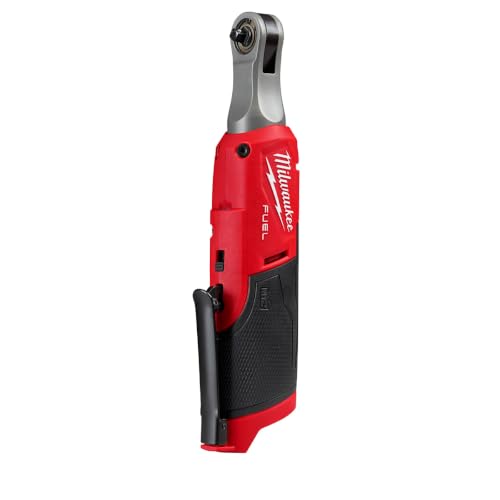
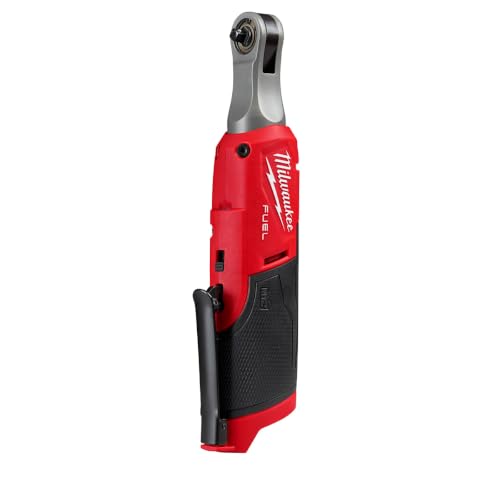
The Milwaukee 2566-20 M12 FUEL Brushless Lithium-Ion is engineered specifically for technicians whose daily workflows involve high-volume fastener removal and installation. Built around a 12-volt brushless motor platform, this tool operates at a maximum rotational speed of 450 RPM, which represents the upper tier of velocity in cordless fastening tools. The physical footprint measures 3 by 11 by 2 inches with an operating weight listed at 1.8 pounds (and 1.93 pounds in packaged specifications). This compact form factor allows mechanics to navigate through cramped engine compartments and industrial enclosures where bulkier pneumatic tools cannot fit.
For assembly specialists and electrical enclosure builders, speed is the primary driver of productivity. When running down long 1/4-inch drive machine screws, the 450 RPM rotational speed of this m12 high speed ratchet substantially cuts cycle times compared to conventional cordless ratchets. The housing features a durable powder-coated finish designed to resist abrasive shop wear, surface impacts, and corrosive fluids. While the listing notes the inclusion of a battery, it also designates the unit as a bare tool model number 2566-20, meaning users should verify power pack availability before deploying it on the line.
Where the milwaukee m12 fuel ratchets like the 2566-20 give way is in high-torque fastener cracking. Because this model prioritizes speed over high-leverage breakaway force, it is less suited for frozen or heavily rusted bolts. Mechanics needing higher torque thresholds or broader socket compatibility will find more utility in 3/8-inch extended reach alternatives that trade top-end RPM for twisting force.
- Brushless 12-volt motor delivering up to 450 RPM free speed
- Dedicated 1/4-inch drive anvil designed for small fastener rundown
- Compact chassis weighing 1.8 pounds with an 11-inch overall length
- Durable powder-coated finish resisting surface wear and shop chemicals
Milwaukee M12 FUEL 1 4" High

Price not listed
Our score: 8.2/10Mostly positive
Brand Milwaukee ASIN B08X9YPGBP
Best for: Automotive technicians needing manual ratcheting
Pros
- 35 foot-pounds torque
- Variable speed metal trigger
- Manual ratcheting override
Cons
- Excludes battery and charger
The Milwaukee M12 FUEL 1 4″ High focuses on torque stability and fine control within restricted mechanical quarters. Delivering 35 foot-pounds of maximum torque, this tool produces sufficient mechanical force to snug down 1/4-inch hardware without risking fastener shank deformation. The chassis measures 11 inches in overall length and weighs 1.6 pounds, pairing an alloy metal head with a rubber overmold body. This overmold protects against corrosive automotive solvents while enhancing grip during oily disassembly procedures.
Control is managed through a variable-speed metal trigger that gives the operator granular throttle modulation, preventing cross-threading during initial fastener engagement. An integrated forward-facing LED work light illuminates dark recesses under dashboards or behind suspension struts. An essential mechanical feature of this listing is its manual ratcheting design: technicians can apply manual muscle force to break stubborn fasteners loose without engaging the electric motor, using the tool as a static hand ratchet before toggling the trigger to spin the fastener free.
Supplied as a bare tool without battery or charger, this model is targeted at professional mechanics who already own compatible 12-volt battery packs. It yields to larger 3/8-inch platform tools when fastener head sizes exceed 13 millimeters or when working on chassis fasteners that require higher torque than its 35 ft-lb ceiling. For users working within the 1/4-inch socket envelope, it provides an exceptional balance of manual tactile feedback and powered rundown speed.
- Motorized output delivering up to 35 foot-pounds of fastening torque
- Variable-speed metal trigger for granular motor throttle control
- Fixed ratchet mechanism permitting manual breaking without motor activation
- Protective rubber overmold resisting corrosion with integrated LED illumination
showingo 42-06-2556 1 4" Ratchet Head

Price not listed
Our score: 8.2/10Mostly positive
Brand Showingo ASIN B084V45J6C
Best for: Technicians repairing broken 2556-20 anvils
Pros
- Direct fit for 2556-20
- Alloy steel construction
- Repairs broken drive end
Cons
- Mechanical service part only
The showingo 42-06-2556 1 4″ Ratchet Head is a dedicated mechanical replacement assembly engineered for technicians maintaining their own cordless fastening tools. Listed under part number 42-06-2556, this anvil service kit is manufactured specifically to fit the 2556-20 cordless ratchet model. Built from alloy steel with a powder-coated black finish, the component restores mechanical square drive engagement when the original anvil has suffered fatigue, ball detent failure, or drive shearing under excessive manual strain.
Cordless ratchets endure high torsional shock loads, particularly when users pull hard on the tool handle to break loose seized fasteners. Over extended service lives, the 1/4-inch drive square is the primary mechanical failure point due to its narrow metal cross-section. Rather than replacing an entire motorized tool assembly, this service kit provides the exact mechanical replacement components needed to rebuild the drive end. The jaw capacity is set to standard 0.25-inch socket retainers, matching factory specifications.
This product is exclusively a mechanical replacement part and contains no electrical motor, battery contacts, or housing components. It suits equipment maintenance specialists, tool rebuilders, and fleet mechanics who need to restore functional operation to a damaged tool. Readers deciding which milwaukee ratchet to buy for new assembly lines will require a fully functional bare tool rather than this internal anvil replacement kit.
- Direct-fit anvil service kit matching mechanical part number 42-06-2556
- Engineered specifically to repair and rebuild the 2556-20 ratchet housing
- High-strength alloy steel construction with protective powder-coated finish
- Fixed 1/4-inch square drive profile with factory-spec socket detent retention
Milwaukee 2457-20 M12 Cordless 3 8"

Price not listed
Our score: 8.8/10Very positive
Brand Milwaukee ASIN B006CSRBTC
Best for: Subcompact engine bay repair mechanics
Pros
- Subcompact 9.47-inch chassis
- Recessed directional switch
- Onboard fuel gauge
Cons
- Lower 250 RPM speed
The Milwaukee 2457-20 M12 Cordless 3 8″ serves as the subcompact baseline for mechanics who require 3/8-inch drive socket compatibility in tight mechanical quarters. Operating on the standard 12-volt battery platform, the motor produces 35 ft-lbs of torque and spins up to 250 RPM. Measuring 9.47 inches in total length and weighing 16 ounces, this model is significantly shorter and lighter than extended-reach options, allowing it to slip into cramped spaces between engine accessories and firewall bulkheads.
Mechanical reliability on the 2457-20 is reinforced by a recessed forward-backward switch located on the rear of the ratchet head. This recessed placement prevents accidental directional changes when the tool head rubs against engine components during operation. Electronic management is handled by onboard Redlink Intelligence, which establishes communication between tool and battery pack to prevent overheating, overcurrent draws, and motor stalling damage. An onboard battery fuel gauge displays remaining charge, while a front-mounted LED illuminates the work plane.
Compared to a specialized 3/8 milwaukee impact ratchet or high-speed FUEL units, the 2457-20 trades raw rotational speed for a sub-10-inch chassis. Its 250 RPM motor is slower than the 450 RPM found on the 2566-20, meaning thread rundown requires slightly more time. However, for technicians working primarily with standard 3/8-inch drive sockets who value light weight and compact clearance above all else, this tool offers balanced daily capability.
- 12-volt subcompact motor generating 35 ft-lbs of torque and 250 RPM
- Short 9.47-inch chassis weighing 16 ounces for tight space accessibility
- Recessed forward-reverse selector switch to prevent accidental switching
- Integrated Redlink Intelligence protecting tool electronics against overload
Milwaukee 2560-20 M12 FUEL 3 8"

Price not listed
Our score: 8.2/10Mostly positive
Brand Milwaukee ASIN B081K8HKWH
Best for: Deep bay access requiring maximum torque
Pros
- 55 foot-pounds peak torque
- Extended 15-inch neck reach
- Cast steel yoke housing
Cons
- Heavier 3-pound tool profile
The Milwaukee 2560-20 M12 FUEL 3 8″ is engineered for extreme reach and heavy-duty fastener management. Built with an extended neck profile that brings the overall tool length to 15 inches, this model allows technicians to access recessed fasteners deep within engine bays, under vehicle cowls, or behind structural crossmembers without requiring extensive disassembly of surrounding parts. The tool weighs 3 pounds and features an alloy steel body coated in red powder paint, built with a cast steel yoke housing and reinforced internal mechanism.
In terms of output, the brushless motor delivers up to 55 ft-lbs of fastening torque, making it the most powerful motorized unit among the evaluated models. This elevated torque capacity allows it to handle larger chassis fasteners, suspension brackets, and water pump assemblies that stall lighter 35 ft-lb units. The tool incorporates Redlink Plus Intelligence, providing advanced digital protection against overheating and thermal degradation during sustained, heavy-duty fastening cycles. Although the listing spec table classifies its operation mode as pneumatic, its structural features, description, and model lineage confirm its battery-operated M12 cordless design.
The trade-off for the 2560-20 lies in clearance and weight. At 15 inches long and 3 pounds, it can be unwieldy within tight, shallow compartments where a short tool is required. Technicians working primarily under dashboards or inside narrow electrical panels will find the 9.47-inch or 11-inch models far easier to handle. However, when reaching deep bolts past obstructed pathways is the objective, the extended neck design of this tool is unmatched.
- Extended neck configuration providing a 15-inch total overall reaching length
- High-output brushless motor generating up to 55 ft-lbs of fastening torque
- Reinforced internal gear mechanism supported by cast steel yoke housing
- Redlink Plus Intelligence electronic protection preventing overload damage
What Sets These Models Apart
Understanding how drive standard, motor architecture, physical dimensions, and torque thresholds interact is essential when choosing the right fastening hardware. The table below outlines the primary technical specifications across each reviewed item to assist in component and tool selection.
| Product Name | Drive Standard | Maximum Speed / Mechanism | Peak Torque Output | Length & Weight |
|---|---|---|---|---|
| Milwaukee 2566-20 M12 FUEL Brushless Lithium-Ion | 1/4 Inch Square | 450 RPM Brushless | The listing does not specify | 11 Inches / 1.8 lbs |
| Milwaukee M12 FUEL 1 4″ High | 1/4 Inch Square (0.25 Jaw) | Variable Speed Trigger | 35 ft-lb | 11 Inches / 1.6 lbs |
| showingo 42-06-2556 1 4″ Ratchet Head | 1/4 Inch Square (0.25 Jaw) | Mechanical Service Kit | Manual Component Limit | 0.25 Inches / Listing omits weight |
| Milwaukee 2457-20 M12 Cordless 3 8″ | 3/8 Inch Square (0.38 Jaw) | 250 RPM Motorized | 35 ft-lb | 9.47 Inches / 16 oz |
| Milwaukee 2560-20 M12 FUEL 3 8″ | 3/8 Inch Square | Brushless Motorized | 55 ft-lb | 15 Inches / 3.0 lbs |
Buying Tips for Milwaukee Cordless Ratchets
When selecting a cordless ratchet, drive size compatibility must dictate your starting point. A 1/4-inch drive ratchet is designed for smaller hardware, typically up to 10 or 12 millimeters, where fastener clearance is restricted and thread pitch is fine. While adapters allow a 1/4-inch anvil to run 3/8-inch sockets, using step-up adapters introduces parasitic torque loss, increases the overall head height, and places higher torsional stress on the anvil shaft. If the bulk of your service work involves hardware larger than 12 millimeters, selecting a native 3/8-inch anvil model such as the 2457-20 or 2560-20 preserves drive integrity and socket stability.
Motor speed versus torque output is the second critical evaluation metric. High-speed units operating at 450 RPM excel at running long threads down quickly, which significantly reduces technician fatigue in high-repetition manufacturing and disassembly environments. However, higher speed often correlates with lower static gear reduction, meaning these tools are not built to break loose seized fasteners under motor power alone. For heavy mechanical teardowns, models with 55 ft-lb ratings provide the necessary power to handle larger bolts without requiring immediate manual wrenching.
Chassis reach and head geometry directly influence whether a tool can access target hardware. Standard subcompact bodies measuring under 10 inches offer superior maneuverability in open compartments, but fail when fasteners are recessed deep inside an engine bay behind steering shafts or coolant piping. In those scenarios, an extended reach frame eliminates the need to remove obstructing components. Additionally, evaluating secondary features like recessed directional switches and steel yoke housings ensures the tool withstands repeated shop floor use without accidental switching or mechanical gear binding.