ELEGOO Multi-Color 3D Printer Lineup: CoreXY Specs and Color Capability Breakdown
Finding the right elegoo multi color 3d printer setup requires understanding the physical difference between automated multi-material switching and fixed single-extruder filament variations. ELEGOO has expanded its hardware catalog from entry-level Cartesian bedslingers into high-speed CoreXY platforms and high-precision resin systems, providing distinct paths for multi-hue fabrication. While true multi-spool automated color printing relies on…

As Amazon Associates, we earn from qualifying purchases. This means we may receive a small commission at no extra cost to you if you click through and make a purchase.
Finding the right elegoo multi color 3d printer setup requires understanding the physical difference between automated multi-material switching and fixed single-extruder filament variations. ELEGOO has expanded its hardware catalog from entry-level Cartesian bedslingers into high-speed CoreXY platforms and high-precision resin systems, providing distinct paths for multi-hue fabrication. While true multi-spool automated color printing relies on mechanical feed switching, automated retraction, and purge cycles, makers can also achieve multi-tone aesthetic surfaces on standard single-extrusion platforms using specialized co-extruded triple-color filaments. Selecting the right setup depends on whether your projects demand discrete multi-part color separation or continuous radial color blending.
This technical hardware analysis covers exactly 6 ELEGOO products, breaking down four high-speed CoreXY and bedslinger FDM machines, one precision multi-color co-extruded filament spool, and one high-resolution LCD resin printer. Through an extensive elegoo multi color 3d printer comparison, we examine how hardware kinematics, hotend thermal limits, and automated material handling define each model’s operational scope. From the automated multi-spool switching of the CANVAS ecosystem to the engineering-grade chamber of carbon-capable systems and the micron-level accuracy of tilt-release photopolymer vats, this guide outlines the specific capabilities across the brand’s production spectrum.
Which ELEGOO 3D Printers Should You Buy
- For automated multi-material feeding and 4-spool layer transitions: ELEGOO Centauri 2 Combo 3D Printer
- For iridescent three-tone exterior finishes on any standard 1.75mm FDM setup: ELEGOO Silk PLA Filament Triple Colors
- For high-temperature composites and reinforced engineering plastics: ELEGOO Centauri Carbon 3D Printer
- For high-speed single-filament CoreXY production without an external feeder: ELEGOO Centauri 2 3D Printer
- For quiet entry-level Cartesian printing on standard single-extrusion filaments: ELEGOO Neptune 3 Pro 3D Printer
- For micron-level miniature sculpting and intricate photopolymer prototypes: ELEGOO Mars 5 Ultra Resin 3D
ELEGOO Centauri 2 Combo 3D Printer
Price not listed
4.6 average from Amazon buyersVery positive
Brand Elegoo ASIN B0GZZ7C12J

Best for: High speed single material CoreXY prototyping
Pros
- 500mm/s print velocity
- Rigid aluminum frame
- Semi-automatic belt tensioner
Cons
- Lacks multi-material feeder
Best for: Automated four spool multi color printing
Pros
- CANVAS 4-color printing
- CoreXY 500mm/s motion
- 22 intelligent sensors
Cons
- Heavier footprint than base unit
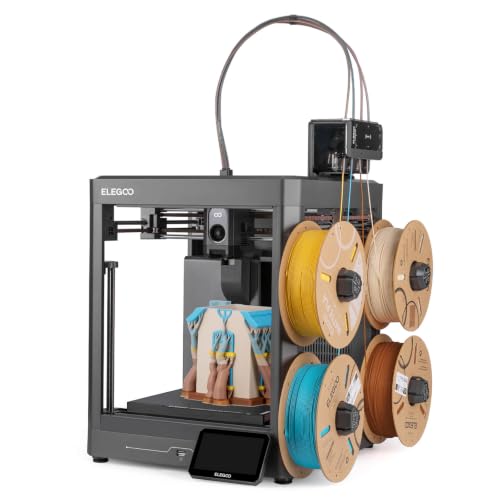
The ELEGOO Centauri 2 Combo 3D Printer serves as the brand’s direct solution for automated multi-filament fabrication. At the core of its color delivery is the integrated CANVAS system, which supports elegoo canvas 4-color printing through independent drive motors, instant material switching, and automatic spool refills. The system incorporates RFID filament recognition to identify spool properties without manual data entry. Built on a rigid metal architecture, the machine balances multi-spool line management with a high-speed CoreXY motion layout capable of hitting print speeds up to 500mm/s and accelerations of 20,000mm/s².
Process reliability during multi-spool jobs is governed by an array of 22 intelligent sensors that monitor operating conditions in real time. Setup complexity is minimized through full automatic calibration and automated pre-print diagnostic checks. To mitigate the surface artifacts that often appear during high-speed directional changes, the printhead utilizes precise extrusion control and vibration compensation. The printer integrates into the broader software workflow via the Nexprint model repository, ELEGOOSlicer, and the ELEGOO Matrix remote monitoring application, competing directly in the space against setups like the bamboo 3d printer multi color alternatives.
Physical maintenance on this 15 kg unit is streamlined through a magnetic printhead cover, a semi-automatic belt tensioner, and a dedicated nozzle wiper that purges molten material between color swaps. While the listing does not specify the exact internal build volume, the external dimensions measure 19.69 inches deep by 18.9 inches wide by 23.23 inches high. Users who only require single-material extrusion without the dedicated CANVAS multi-spool rack may find the standalone Centauri 2 a more compact desktop fit.
- CANVAS 4-color printing unit with independent motors, RFID recognition, and auto refill
- CoreXY motion platform delivering up to 500mm/s print velocity and 20,000mm/s² acceleration
- Array of 22 real-time monitoring sensors paired with full automated pre-print calibration
- Maintenance hardware including semi-automatic belt tensioning and an integrated nozzle wiper
ELEGOO Silk PLA Filament Triple Colors

Price not listed
4.3 average from Amazon buyersMostly positive
Brand Elegoo ASIN B0CW1N45K1
Best for: Coextruded gradient finishes on single nozzles
Pros
- Tri-color silk blend
- Tight +/-0.05mm tolerance
- Vacuum-sealed packaging
Cons
- Single strand color layout
The ELEGOO Silk PLA Filament Triple Colors provides an alternate route to multi-tone models without requiring a specialized multi-spool feeding mechanism. This 1 kg spool incorporates three distinct color pigments—orange, blue, and green—co-extruded into a single continuous 1.75mm strand. As the extruder deposits the molten thermoplastic, the orientation of the model relative to the nozzle creates a dynamic, shifting sheen across the outer perimeters. This delivers a striking visual finish on static decorative prints without the purge waste and time penalties associated with mechanical material retraction.
Manufactured from high-grade polylactic acid, the filament exhibits low thermal shrinkage and minimal warping characteristics, making it compatible with non-enclosed print beds. The spool undergoes strict mechanical winding to ensure tangle-free unwinding, while an inline manufacturing tolerance maintains dimensional consistency within +/- 0.05 mm. Shoppers who regularly stock options such as the sunlu pla color pack will appreciate that this spool is thoroughly dried before packaging and vacuum-sealed to prevent ambient moisture absorption, which mitigates bubbling and hotend clogging.
Because the color distribution is fixed longitudinally throughout the filament strand, this product cannot place specific colors onto isolated model features on demand. For functional multi-part models requiring distinct black, white, or red boundaries on designated coordinates, an automated multi-channel system like the Centauri 2 Combo remains necessary. For display models, vases, and artistic sculptures, however, this tri-color filament produces smooth chromatic transitions with standard single-extrusion g-code.
- Co-extruded silk formulation combining orange, blue, and green into one 1.75mm strand
- Dimensional accuracy held to a tight tolerance of +/- 0.05 mm across the entire 1 kg spool
- Mechanically wound spooling sealed with desiccant in a moisture-barrier vacuum pack
- Universal compatibility with standard 1.75mm FDM direct drive and Bowden extruders
ELEGOO Centauri Carbon 3D Printer

Price not listed
4.2 average from Amazon buyersMostly positive
Brand Elegoo ASIN B0FDQP54X8
Best for: Enclosed composite and high temperature printing
Pros
- 320°C hardened steel nozzle
- Enclosed chamber cooling
- Integrated AI chamber camera
Cons
- Single filament feed out of box
Engineered specifically for challenging technical filaments, the ELEGOO Centauri Carbon 3D Printer prioritizes thermal capacity and chamber control over native multi-color feeding. It features an integrated die-cast aluminum frame that minimizes chassis resonance when moving at 500 mm/s with 20,000 mm/s² acceleration. Unlike open-frame bedslingers, the Centauri Carbon provides an enclosed chamber with enhanced cooling designed to maintain steady environmental temperatures during the deposition of engineering-grade thermoplastics, positioning it alongside commercial workhorses like the flash forge 3d printer series.
The hotend assembly is built around a 320°C brass-hardened steel nozzle, paired with a high-flow hotend and a high-output heated bed. This thermal setup allows the machine to reliably process abrasive carbon fiber reinforced filaments alongside standard polymers. The build chamber accommodates parts up to 256x256x256 mm (10x10x10 inches) on an upgraded dual-sided build plate equipped with a specialized PLA-specific adhesion surface. Print quality is continuously adjusted using automated vibration compensation and dynamic pressure advance algorithms.
Remote observation is handled by a built-in internal chamber camera and dual LED lighting strips, allowing users to track layer integrity and record time-lapse sequences. While the machine arrives fully assembled and calibrated out of the box, its single-extrusion pathway is configured for strength and material toughness rather than multi-spool automated color blending. Users prioritizing composite structural stiffness over multicolor decorative detailing will find this enclosed platform better suited to their technical requirements.
- High-temperature 320°C brass-hardened steel nozzle engineered for carbon fiber composites
- Enclosed build chamber with auxiliary cooling and a spacious 256x256x256 mm build volume
- Rigid die-cast aluminum chassis supporting 500 mm/s speed and 20,000 mm/s² acceleration
- Integrated AI chamber camera with dual LED lighting for real-time monitoring and time-lapses
ELEGOO Centauri 2 3D Printer

Price not listed
4.3 average from Amazon buyersMostly positive
Brand Elegoo ASIN B0GZYZY956
The ELEGOO Centauri 2 3D Printer provides the high-velocity CoreXY mechanical platform of the flagship series without the added footprint of an external multi-filament feeder. Operating at travel speeds up to 500 mm/s with 20,000 mm/s² acceleration, this standalone machine delivers rapid iteration cycles for rapid prototyping. Its motion system is anchored by a rigid metal frame and precision linear guides that preserve positioning accuracy and sharp perimeter definition under extreme acceleration profiles.
Operational workflow is managed through a front-mounted 5-inch color touchscreen interface. Setup routines are fully automated through smart pre-print checks and automatic calibration routines that eliminate manual bed adjustments. Active vibration compensation and fine-tuned extrusion control prevent ringing and ghosting on thin-walled components. Software integration mirrors the rest of the ecosystem, supporting model slicing through ELEGOOSlicer, mobile control via the ELEGOO Matrix app, and direct downloads from the Nexprint library.
Weighing 13.7 kg with an external footprint of 15.91 inches deep by 15.67 inches wide by 19.29 inches high, this model is noticeably lighter and more compact than its multi-spool sibling. Routine upkeep is simplified by a magnetic printhead shroud, an integrated nozzle cleaning wiper, and semi-automatic belt tensioning hardware. Although the listing does not specify its exact build envelope, the Centauri 2 is the ideal single-material selection for makers who need fast CoreXY throughput without the hardware overhead of the CANVAS multi-color mechanism.
- Rigid metal CoreXY chassis engineered for 500 mm/s velocities and 20,000 mm/s² acceleration
- Automated multi-point calibration routines and intelligent sensor-driven pre-print diagnostics
- User-focused 5-inch touchscreen interface paired with remote ELEGOO Matrix app control
- Streamlined maintenance hardware including semi-automatic belt adjusters and nozzle wipers
ELEGOO Neptune 3 Pro 3D Printer

Price not listed
4.0 average from Amazon buyersMostly positive
Brand Elegoo ASIN B0BJCQ59JS
Best for: Quiet entry level Cartesian bed printing
Pros
- Dual-gear direct drive extruder
- 36-point auto bed leveling
- Dual Z-axis lead screws
Cons
- Lower throughput than CoreXY
Representing ELEGOO’s mature Cartesian architecture, the ELEGOO Neptune 3 Pro 3D Printer is designed for hobbyists seeking straightforward single-material FDM fabrication. Its 225x225x280 mm (8.85×8.85×11 inch) build volume accommodates everyday mechanical brackets and artistic models. Movement along the vertical axis is stabilized by dual lead screws driven by dual synchronized stepper motors, riding on durable POM V-guide wheels to prevent gantry sag and layer inconsistencies across tall geometries.
Material extrusion is driven by a dual-gear direct drive extruder constructed from SUS303 stainless steel with a 3:1 gear reduction ratio. This high-grip mechanism ensures smooth, consistent feeding of flexible TPU, rigid PLA, PETG, and ABS without filament slippage. The hotend combines a titanium alloy throat tube with a standard brass nozzle, supported by a widened aluminum heat sink and an efficient front-mounted cooling fan that prevents heat creep during long-duration prints.
First-layer consistency is automated by a non-contact 36-point auto bed leveling sensor, while an STM32 motherboard with silent stepper motor drivers keeps ambient operational noise down to 47 dB. Integrated fail-safes include a mechanical filament runout sensor and a power-loss recovery routine. While its moving bed architecture limits it to lower acceleration values than CoreXY machines, its simplicity and accessible maintenance make it a reliable single-extrusion platform for standard prototyping.
- Dual-gear SUS303 stainless steel direct drive extruder featuring a powerful 3:1 gear ratio
- Sturdy 225x225x280 mm build envelope stabilized by dual synchronized Z-axis lead screws
- Non-contact 36-point auto bed leveling matrix backed by low-noise 47 dB silent motor drivers
- Upgraded hotend design with a titanium throat tube and high-efficiency front cooling fan
ELEGOO Mars 5 Ultra Resin 3D
Price not listed
4.2 average from Amazon buyersMostly positive
Brand Elegoo ASIN B0D3TMS8DF
Best for: Ultra high detail miniature resin fabrication
Pros
- 9K 18μm XY resolution
- 150mm/h tilt release speed
- AI failure detection camera
Cons
- Requires liquid photopolymer resin
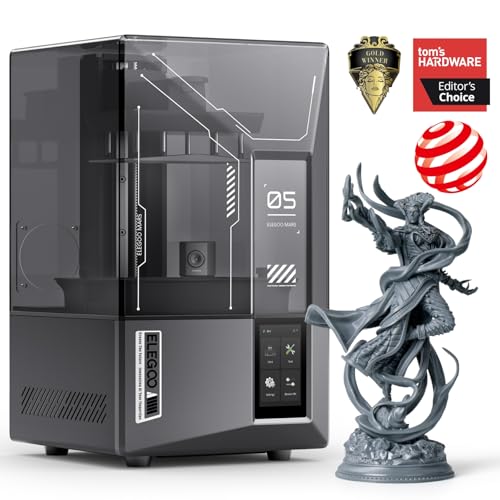
For makers deciding on which elegoo 3d printer to buy when microscopic dimensional accuracy is the top priority, the ELEGOO Mars 5 Ultra Resin 3D operates on an entirely different manufacturing principle. Instead of depositing molten plastic through a heated nozzle, this photopolymer vat system cures liquid resin using a 7-inch monochrome LCD screen. With a 9K ultra-high resolution and an 18 μm XY pixel pitch, the machine renders intricate facial expressions, crisp jewelry filigree, and fine miniature textures that FDM extrusion widths cannot replicate.
Print cycles are accelerated by a mechanical tilt-release vat mechanism that systematically peels the cured layer off the release film, allowing vertical print speeds up to 150 mm/h. To safeguard against optical and mechanical failures, the printer incorporates an onboard AI camera that monitors layer formation in real time to detect warping or detached prints. Additionally, a smart mechanical sensor provides active residue detection in the resin tank to prevent cured debris from cracking the LCD panel during the downward home stroke.
Measuring 21.85 inches deep by 14.57 inches wide by 13.39 inches high and weighing 8.8 kg, the Mars 5 Ultra also supports Wi-Fi cluster management for synchronized farm production. When analyzing elegoo fdm vs resin specs, resin technology cannot output multi-colored prints within a single vat cycle without post-process painting. However, for tabletop miniatures, detailed jewelry casts, and dental prototypes where surface smoothness outweighs the convenience of multi-material extrusion, this high-speed resin unit outperforms filament printers on raw feature resolution.
- 7-inch 9K monochrome LCD panel achieving a microscopic 18 μm XY detail resolution
- Rapid tilt-release vat peeling technology delivering layer speeds up to 150 mm/h
- Intelligent mechanical sensor detecting tank debris, resin shortages, and leveling errors
- Integrated AI failure-detection camera with support for multi-machine Wi-Fi cluster control
What Sets These Models Apart
| Model | Kinematic Architecture | Max Speed / Rate | Material & Color Delivery |
|---|---|---|---|
| ELEGOO Centauri 2 Combo 3D Printer | High-Speed CoreXY (Enclosed/Rigid Metal) | 500 mm/s (20,000 mm/s² acceleration) | CANVAS 4-Color multi-spool automated feeder |
| ELEGOO Silk PLA Filament Triple Colors | Standard FDM Spool (Universal 1.75mm) | Printer Dependent | Co-extruded Orange/Blue/Green single strand |
| ELEGOO Centauri Carbon 3D Printer | Enclosed CoreXY (Die-Cast Aluminum) | 500 mm/s (20,000 mm/s² acceleration) | Single 320°C hardened nozzle for composites |
| ELEGOO Centauri 2 3D Printer | High-Speed CoreXY (Rigid Metal Frame) | 500 mm/s (20,000 mm/s² acceleration) | Single-extruder standard thermoplastic feed |
| ELEGOO Neptune 3 Pro 3D Printer | Cartesian Bed-Slinger (Dual Z-Axis) | Standard Cartesian Velocities | Direct drive 3:1 single-material extruder |
| ELEGOO Mars 5 Ultra Resin 3D | Vat Photopolymerization (Tilt Release LCD) | Up to 150 mm/h vertical build rate | Liquid photopolymer resin (Single vat color) |
Buying Tips for ELEGOO 3D Printers
Choosing between an automated multi-material FDM printer and a dedicated single-extrusion machine begins with assessing your project goals and waste tolerance. Systems equipped with automated multi-spool switchers, like the CANVAS setup, retract and reload filament at every color layer transition. This process generates purge waste and increases overall print duration, but it is necessary for placing specific colors on distinct model parts. In contrast, co-extruded filaments such as Silk Tri-Color deliver continuous rainbow or iridescent effects on any single-nozzle machine with zero purge waste, though without coordinate-specific color control.
Kinematic architecture is another critical design factor when comparing modern ELEGOO printers. The CoreXY motion system used in the Centauri family moves the printhead along stationary overhead belts while the build platform moves downward along the Z-axis. This structure minimizes moving mass, enabling reliable travel speeds of 500 mm/s without shaking the printed part. Conversely, traditional Cartesian bedslingers like the Neptune 3 Pro move the heavy heated bed back and forth along the Y-axis, which limits maximum acceleration but provides a mechanically simple, cost-effective platform that is easy to service.
Finally, evaluate the fundamental material divide between thermoplastic filament and liquid photopolymer resin. FDM printers excel at large-format functional assemblies, durable structural components, and multi-color visual prototypes. Resin printers like the Mars 5 Ultra operate in a different manufacturing category: they produce solid-tone parts with smooth layer blending and microscopic 18 μm resolution. While resin parts require chemical washing and ultraviolet curing, they remain the superior choice for high-detail miniatures, jewelry patterns, and dental molds where layer lines cannot be tolerated.