Bambu Lab Smooth PEI Plates Compared: Technical Specs and Sizing Breakdown
A smooth PEI plate provides the flat, mirror-sheen bottom layer required for functional assemblies, precision interlocking components, and engineering prototypes produced on Bambu Lab 3D printers. Unlike powder-coated textured beds that deposit a stippled surface finish, smooth polyetherimide sheets rely on a planar film or fine-matte sheet to establish continuous contact across the entire first…

As Amazon Associates, we earn from qualifying purchases. This means we may receive a small commission at no extra cost to you if you click through and make a purchase.
A smooth PEI plate provides the flat, mirror-sheen bottom layer required for functional assemblies, precision interlocking components, and engineering prototypes produced on Bambu Lab 3D printers. Unlike powder-coated textured beds that deposit a stippled surface finish, smooth polyetherimide sheets rely on a planar film or fine-matte sheet to establish continuous contact across the entire first layer. This tight surface mating maximizes mechanical adhesion during deposition, prevents dimensional warping across broad footprints, and produces clean bottom contact surfaces for mechanical parts.
This technical comparison evaluates 6 build plates designed for or cross-referenced with modern desktop platforms, examining how each sheet balances magnetic adhesion, thermal operating limits, and dimensional fit. Across these six options, specifications diverge significantly: standard format beds provide 257x257mm build surfaces while mini platforms require 184x184mm layouts; core substrates vary from 0.5mm magnetic stainless steel to lightweight flexible spring steel; and thermal ceilings span from 70°C low-temperature film limits up to 300°C powder-coat thresholds. Evaluating these technical metrics reveals the exact thermal and mechanical boundaries each plate imposes on your workflow.
Which Bambu Lab Smooth PEI Plates Should You Buy
- For high-temperature technical filaments requiring up to 200°C smooth and 300°C textured thermal ceilings, choose the PEI Build Plate for Bambu Lab.
- For maximum Z-axis dimensional stability and rigid 0.5mm magnetic stainless steel construction, select the Bamboo Original Dual-Sided Textured Smooth PEI.
- For users operating Anycubic Kobra ecosystems who need flame-resistant Polyethylene spring steel, evaluate the Kobra S1 Build Plate for Anycubic.
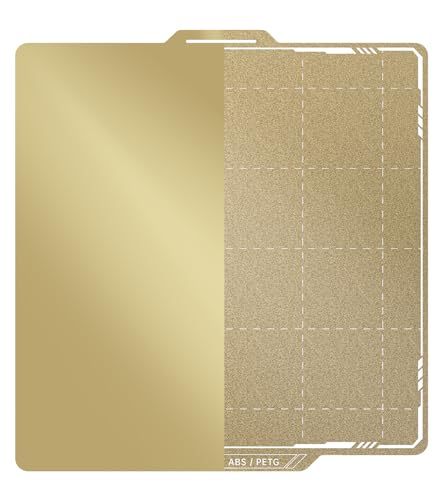
- For dual-texture versatility on standard beds with a 260°C golden yellow high-temp rating, pick the BIQU PyroGrip Smooth PEI+Textured PEI Build.
- For an ultra-lightweight 257x257mm dual-sided sheet that requires zero adhesives across broad polymer profiles, purchase the Smooth&Textured PEI Build Plate for Bambu.
- For dedicated Bambu Lab A1 Mini machines requiring low-temperature 30°C PLA printing and glossy smooth finishes, deploy the Upgraded Low-Temp Cool Plate+ Smooth PEI.
PEI Build Plate for Bambu Lab

Price not listed
Our score: 9.2/10Very positive
Brand Uni Tak3D ASIN B0C5JCJMV7
Best for: High-temperature engineering filament printing
Pros
- Dual-sided smooth and textured surfaces
- 300°C textured thermal ceiling
- Wide polymer compatibility
Cons
- Requires glue stick for non-PLA filaments
- 1 ounce overall weight
The PEI Build Plate for Bambu Lab manufactured by UniTak3D (model Uni104A1P) is an engineering-focused print bed designed to fit platform dimensions of 257x257mm. Built with a dual-sided configuration, this sheet combines a black textured PEI side with a dedicated smooth PEI surface. The smooth side produces an ultra-flat bottom finish on completed models, allowing clean part removal without requiring aggressive bending of the underlying spring steel sheet. The physical product weighs 13.1 ounces, delivering a solid feel that seats securely across the magnetic heated bed platform without lifting along the perimeter.
Thermal specifications on this build plate cater directly to technical filament processing. The black textured PEI coating withstands temperatures up to 300°C, while the smooth PEI side is rated to withstand thermal loads up to 200°C. This high operating range allows users to process demanding polymers including PLA, ABS, ASA, PETG, TPU, Nylon, PA, and PC. The listing notes that while PLA prints reliably on the smooth surface without bonding aids, the smooth PEI side requires 3D printing glue sticks for non-PLA materials to prevent unexpected model detachment during shrinkage phases.
Operational instructions from the manufacturer emphasize surface care and recalibration. Users must peel off the protective transport film from the smooth PEI side prior to initial commissioning. Because the textured and smooth surfaces possess distinct layer profiles, the platform must be releveled whenever flipping between sides. Maintenance requires waiting until the heated bed fully cools to room temperature before lifting finished models to preserve surface integrity, followed by wiping down the plate with a soft cloth rather than harsh chemical reagents.
- Dual-sided architecture featuring 200°C heat-resistant smooth PEI and 300°C black textured PEI
- Standard 257x257mm sizing compatible with Bambu Lab X1, X1C, X1E, P1P, P1S, A1, X2D, and P2S models
- Certified filament compatibility spanning PLA, ABS, ASA, PETG, TPU, Nylon, PA, and PC
- Removable spring steel core weighing 13.1 ounces for repeatable model pop-off
Bamboo Original Dual-Sided Textured Smooth PEI

Buyer favouriteScored 9.4/10 or higher
Price not listed
Our score: 9.8/10Overwhelmingly positive
Brand Comtree ASIN B0F3D31V49
Best for: Users prioritizing Z-axis dimensional precision
Pros
- Thick 0.5mm magnetic stainless steel
- Matte smooth bottom surface finish
- Self-releases prints after cooling
Cons
- Heaviest plate at 1.15 pounds
- Occasional glue needed for specific filaments
The Bamboo Original Dual-Sided Textured Smooth PEI from COMTREE is engineered for operators who prioritize rigidity and vertical layer precision. At the heart of this 257x257mm plate is a 0.5mm magnetic stainless steel core. This increased core thickness enhances magnetic pull against the printer heatbed, actively preventing plate lift or corner warping when depositing dense structural infills. The overall assembly weighs 1.15 pounds, making it the most substantial spring steel sheet in this comparison.
One side of this reversible sheet utilizes a specially selected matte PEI surface designed to produce a smooth, matte finish across the bottom layer of printed components. According to the listing specifications, this smooth surface contributes directly to improved Z-axis precision during the printing sequence, ensuring dimensional accuracy and geometric consistency along vertical axes. Builders who regularly compare surface finishes against a bambu holographic build plate will appreciate the understated, matte presentation delivered by this smooth sheet.
The alternate side features an industrial textured PEI coating that maximizes first-layer bonding durability without requiring adhesive helpers for standard filaments, though glue remains recommended for specific demanding polymers. Both sides take advantage of natural thermal expansion cycles: when the heated bed reaches room temperature, printed components release automatically without forcing or scraping the surface. The plate is compatible with Bambu Lab X1C, X1, X1E, P1P, P1S, and A1 printers.
- Thick 0.5mm magnetic stainless steel substrate designed to prevent plate warping under tension
- Smooth matte PEI surface formulated to enhance Z-axis vertical printing accuracy
- Textured PEI reverse face providing self-releasing first-layer adhesion upon cooling
- Heavyweight 1.15-pound structural build for maximum magnetic bed hold
Kobra S1 Build Plate for Anycubic

Price not listed
Our score: 8.0/10Mostly positive
Brand Hzda Deve ASIN B0G1L7X2R5
Best for: Anycubic Kobra series platform owners
Pros
- Flame-resistant Polyethylene build
- Double-sided textured spray PEI
- Flexible spring steel sheet
Cons
- Listing does not specify Bambu compatibility
- Lacks smooth PEI surface
The Kobra S1 Build Plate for Anycubic, produced by HzdaDeve, is a specialty replacement sheet included in multi-platform workshop cross-evaluations. According to its manufacturer specifications, this build surface is built specifically for Anycubic Kobra S1, Kobra X, and Kobra 4 Combo printers. The listing does not specify standard Bambu Lab machine compatibility or 257x257mm dimensions, making physical sizing verification mandatory before attempting cross-platform mounting.
The structural core of the plate is fabricated from high-strength Polyethylene, engineered to provide inherent flame resistance and minimal smoke generation under thermal exposure. hzdaDeve pairs this core with a double-sided textured spray PEI spring steel construction. Both sides feature identical textured finishes, providing redundant printing surfaces that extend overall service life when running abrasive or high-adhesion materials.
Flatness is a major mechanical focus of this listing, which specifies that the plate provides an exceptionally flat build surface across the market. This uniform horizontal plane ensures consistent first-layer squish across the entire bed. Once printing finishes, model removal requires lifting the flexible sheet from the heated base and gently flexing the spring steel core, allowing prints to detach without mechanical scrapers.
- Double-sided textured spray PEI spring steel configuration for reversible operation
- Polyethylene-based composition offering flame retardant and low-smoke properties
- Engineered for high horizontal flatness across the active printing area
- Flexible spring steel core designed for quick manual pop-off release
BIQU PyroGrip Smooth PEI+Textured PEI Build
Buyer favouriteScored 9.4/10 or higher
Price not listed
Our score: 9.8/10Overwhelmingly positive
Brand BIQU ASIN B0D2RB368V
Best for: High-temp Bambu printing with visual finish options
Pros
- 260°C maximum thermal resistance
- Dual-sided golden yellow surfaces
- High-flatness spring steel substrate
Cons
- Requires disabling P2S plate detection
- 4 ounce overall package mass
The BIQU PyroGrip Smooth PEI+Textured PEI Build plate brings a high-visibility golden yellow aesthetic and precision engineering to standard Bambu platforms. Sized at exactly 257x257mm, this double-sided sheet is fully compatible with Bambu Lab P1P, P1S, P2S, X2D, X1C, X1E, and A1 printers. BIQU notes a critical firmware requirement: users running this build plate on the P2S platform must disable the printer build plate printing detection feature prior to starting a job to avoid false-positive error prompts.
The PyroGrip plate combines a golden yellow matte smooth PEI surface on one face with a rugged textured PEI surface on the other. Both sides withstand continuous operational temperatures up to 260°C, providing ample thermal headroom for printing standard materials like PLA and TPU, as well as higher-temperature polymers like ABS and technical bambu lab petg formulations. The high thermal stability prevents delamination of the PEI coating when operating near the upper limits of the heated bed.
Weighing 13.4 ounces with package dimensions of 11.26 x 10.35 x 0.43 inches, the PyroGrip Panda build plate is engineered with tight flatness tolerances. The magnetic steel plate aligns cleanly with the edge slots of the Bambu heated platform, creating an airtight magnetic seal. Once the print cycle completes, models pop free with minimal manual flex, preventing stress marks or cosmetic warping on flat bottom surfaces.
- Dual-sided golden yellow finish featuring smooth PEI and textured PEI working faces
- High thermal resistance rated up to 260°C across both functional surfaces
- Standard 257x257mm dimensional footprint aligning with Bambu bed alignment notches
- Multi-polymer support covering PLA, PETG, TPU, and ABS filaments
Smooth&Textured PEI Build Plate for Bambu

Price not listed
Our score: 8.0/10Mostly positive
Brand Tiopy ASIN B0FCFT6XFJ
Best for: Budget-conscious Bambu builders wanting lightweight sheets
Pros
- Lightweight 8.1 ounce construction
- Exceeds 200°C thermal threshold
- Supports wide range of technical filaments
Cons
- No QR code for automatic detection
- Requires manual bed sensor bypass
The Smooth&Textured PEI Build Plate for Bambu manufactured by TIOPY offers an ultra-lightweight, 8.1-ounce spring steel solution for standard 257x257mm print beds. Compatible with Bambu Lab X2D, X1C, X1, X1E, P1P, P1S, A1, and P2S printers, this black double-sided plate combines smooth PEI and textured PEI on a single flexible sheet. The listing package details note the inclusion of a non-magnetic base alongside the double-sided spring steel plate, providing installation flexibility for diverse machine beds.
A crucial technical consideration noted in the product specification is the total absence of a printed QR identification code on the plate surface. Because the machine cannot optical-scan the sheet type, operators running Bambu Lab printers with micro-lidar or optical bed inspection must disable the build plate detection function in printer settings before launching prints. Once disabled, the plate supports high-temperature cycles exceeding 200°C without risk of surface degradation or adhesive separation.
Adhesion performance on this TIOPY sheet is tuned for beginner-friendly, glue-free operation across an extensive catalog of materials. Supported filaments include standard PLA, flexible TPU, wood composites, ABS, PC, PETG, and Nylon. When prints finish, the model drops free automatically as the platform cools down to room temperature. Ongoing maintenance requires washing the plate with mild dish soap and warm water to strip skin oils; strong chemical cleaners must be avoided to prevent damaging the PEI coating.
- Ultralight 8.1-ounce spring steel construction for minimal bed inertia
- Thermal ceiling exceeding 200°C for advanced materials including Nylon and PC
- Glue-free adhesion with automatic part release at ambient room temperature
- Requires disabling optical build plate detection due to unprinted QR region
Upgraded Low-Temp Cool Plate+ Smooth PEI

Price not listed
Our score: 8.8/10Very positive
Brand G-Hubble ASIN B0GT3SL1Q4
Best for: Bambu Lab A1 Mini low-temperature printing
Pros
- Custom 184x184mm A1 Mini sizing
- Energy-saving 30°C PLA adhesion
- Glossy smooth PEI film side
Cons
- Black film side capped at 70°C
- Incompatible with standard 257x257mm beds
The Upgraded Low-Temp Cool Plate+ Smooth PEI produced by G-Hubble is engineered exclusively for the compact 184x184mm build platform of the Bambu Lab A1 Mini. Weighing just 6.7 ounces, this dual-sided sheet provides two distinct surface chemistries tailored for energy-efficient, low-temperature additive manufacturing. The sheet cannot be used on full-sized 257x257mm machines, serving exclusively as a specialized upgrade for the A1 Mini ecosystem.
The green face of the plate functions as an advanced low-temperature cold plate, featuring an upgraded PEI powder formula that yields an ultra-fine matte finish without the traditional orange peel texture of standard textured plates. This surface grips prints firmly at dramatically reduced bed temperatures: PLA bonds securely between 30°C and 50°C, PETG between 50°C and 70°C, and ABS between 70°C and 90°C, cutting power consumption and preventing base warping. Neither side requires glue stick, tape, or surface primers.
The reverse side features an imported black smooth PEI film engineered to produce a high-gloss, mirror-smooth finish on bottom layers. This smooth film functions under strict thermal boundaries: PLA prints at 55°C to 70°C, and quality PETG operates at or below 70°C. The manufacturer warns explicitly that temperatures must not exceed 70°C on the black film side. Initial setup requires peeling the protective film from the black side only, seating the plate, and tramming the bed to standard A4 paper clearance. Managing filament feeds from a bambu labs filament spool setup pairs cleanly with these low-energy bed targets.
- Dedicated 184x184mm sizing designed exclusively for the Bambu Lab A1 Mini
- Dual-action surfaces featuring a green low-temperature cold plate and black smooth PEI film
- Energy-saving operation supporting PLA printing down to 30°C without adhesives
- Strict 70°C maximum thermal operating limit on the black smooth PEI film surface
What Sets These Models Apart
Comparing smooth and hybrid PEI build plates requires evaluating mechanical dimensions, substrate thickness, maximum thermal thresholds, and sensor compatibility. The table below details the exact technical parameters specified across all six reviewed plates.
| Product Name | Platform Dimensions | Thermal Limits | Surface Configurations | Substrate and Features |
|---|---|---|---|---|
| PEI Build Plate for Bambu Lab | 257x257mm | 200°C Smooth / 300°C Textured | Black Smooth PEI + Black Textured PEI | 13.1 oz Spring Steel; glue recommended for non-PLA |
| Bamboo Original Dual-Sided Textured Smooth PEI | 257x257mm | Not specified | Matte Smooth PEI + Textured PEI | 1.15 lbs; 0.5mm Magnetic Stainless Steel Core |
| Kobra S1 Build Plate for Anycubic | Not specified | Not specified | Dual-Sided Textured Spray PEI | Polyethylene flame-resistant core; Kobra specific |
| BIQU PyroGrip Smooth PEI+Textured PEI Build | 257x257mm | 260°C Maximum | Golden Yellow Smooth PEI + Textured PEI | 13.4 oz Spring Steel; requires P2S sensor bypass |
| Smooth&Textured PEI Build Plate for Bambu | 257x257mm | Over 200°C | Black Smooth PEI + Black Textured PEI | 8.1 oz Spring Steel; includes non-magnetic base; no QR code |
| Upgraded Low-Temp Cool Plate+ Smooth PEI | 184x184mm | 70°C Smooth Film / 90°C Cold Plate | Black Smooth Film + Green Matte Cold Plate | 6.7 oz Spring Steel; A1 Mini exclusive; low-temp 30°C PLA |
Buying Tips for Bambu Lab Smooth PEI Plates
Selecting the right smooth PEI plate requires matching plate thermal ratings to the specific filament families you plan to print. Standard smooth PEI film creates an exceptionally dense bond with high-temperature polymers. When working with materials like PETG, TPU, ABS, or PC on high-temp smooth sheets like the UniTak3D or BIQU models, you must use a thin layer of glue stick as a release interface rather than an adhesion promoter. Without this barrier, molten PETG and TPU can chemically fuse to the smooth PEI layer, permanently tearing the coating upon removal. Conversely, low-temperature specialty sheets like the G-Hubble plate utilize specialized films capped at 70°C that release cleanly without adhesives when operated within strict temperature limits.
Printer firmware interactions represent another vital technical factor. Bambu Lab X1-series and P-series machines utilize optical sensors or micro-lidar to inspect build surface placement and read the printed localization QR code on the front tab. Third-party plates, including options from TIOPY and BIQU, frequently omit these proprietary QR identifiers. When running these aftermarket plates, operators must enter the machine settings menu or slicer print dialog and manually disable the build plate detection feature. Failing to bypass this detection routine will cause the machine to pause prior to the first layer, generating an unrecognized plate warning error.
Long-term maintenance directly governs first-layer success on any smooth PEI surface. Unlike textured beds whose valleys can trap microscopic debris without sacrificing entire contact patches, smooth PEI relies on 100 percent direct physical contact. Fingerprint oils and airborne dust compromise this bond immediately. Clean your plate regularly using warm water and basic dish soap that contains no skin lotions or fragrances, drying the surface thoroughly with a lint-free microfiber towel. Never wipe smooth PEI sheets with harsh chemical solvents, acetone, or abrasive scrubbers, as these compounds degrade the polymer film and strip away the mirror-flat finish.