Anker 25K & High-Capacity Power Bank Comparison: Spec Analysis
Finding the right portable power source in the high-capacity bracket requires evaluating sustained wattage delivery, port allocations, and electrical energy density. When evaluating an anker power bank 25 option or adjacent high-capacity solutions, technical buyers must look beyond headline milliamp-hour numbers to understand how energy is distributed under heavy simultaneous workloads. Selecting an anker 25000…

As Amazon Associates, we earn from qualifying purchases. This means we may receive a small commission at no extra cost to you if you click through and make a purchase.
Finding the right portable power source in the high-capacity bracket requires evaluating sustained wattage delivery, port allocations, and electrical energy density. When evaluating an anker power bank 25 option or adjacent high-capacity solutions, technical buyers must look beyond headline milliamp-hour numbers to understand how energy is distributed under heavy simultaneous workloads. Selecting an anker 25000 mah power bank or a related multi-cell unit ensures your mobile workstation maintains full operational speed without encountering thermal throttling or sudden port resets during peak computing tasks.
This technical comparison examines six distinct power banks manufactured by Anker, spanning dedicated ultra-compact wireless units up to flagship 27,650mAh heavyweights. We dissect single-port wattage ceilings ranging from 15W Qi2 wireless up to 140W Power Delivery 3.1, aggregate multi-device power distributions up to 250W, and chassis engineering across varying watt-hour ratings. Through this structured anker power bank comparison, you can align exact power consumption profiles, cable configurations, and travel constraints to determine which pack meets your mobile operational demands.
Which Anker Power Banks Should You Buy
- For mobile professionals who require built-in cables and multi-port 100W laptop versatility, choose the Anker Laptop Power Bank.
- For commuters seeking lightweight everyday smartphone pocket carry with integrated cabling, choose the Anker Zolo Power Bank,20,000mAh 30W Portable.
- For power users demanding maximum allowable flight capacity and 250W multi-device throughput, choose the Anker Prime Power Bank with 27,650mAh.
- For frequent flyers wanting 140W single-port laptop delivery in a lighter 20,100mAh chassis, choose the Anker Prime Power Bank with 220W output.
- For technical users prioritizing two-way 140W charging speeds with detailed screen diagnostics, choose the Anker 737 Power Bank.
- For minimalist iPhone users needing snap-on wireless power in a pocket-thin profile, choose the Anker Nano Magnetic Power Bank.
Anker Laptop Power Bank

Price not listed
Our score: 9.0/10Very positive
Brand Anker ASIN B0DCBB2YTR
Best for: Mobile workstation users needing built-in cables
Pros
- Triple 100W USB-C output ports
- Dual integrated durable cables
- 165W combined multi-port output
Cons
- Wall charger not included
- Bulkier travel profile
The Anker Laptop Power Bank targets field engineers and digital professionals who cannot afford cable clutter or power bottlenecks. Engineered with an internal capacity of 25,000mAh, this portable reserve delivers a combined 165W total output across its connection array. Its architecture stands out by offering triple 100W USB-C ports, enabling high-demand hardware to pull serious power from any available USB-C connection point without forcing users to identify a single dedicated priority socket.
Cabling logistics are streamlined through two integrated USB-C cords built directly into the housing. One cord extends up to 2.3 feet and is tested for 20,000 retractions, while the secondary 0.98-foot cable doubles as a structural carry strap rated for over 20,000 bends. Supported by an additional USB-C port and a legacy USB-A port, this pack charges four devices at once while staying fully compliant with the standard 100Wh airline carry-on threshold. Rapid recharging is supported when paired with a 100W or higher wall unit, though the listing specifies that the wall charger is not included in the package.
Where this anker laptop power bank yields to higher-tier models like the Prime series is in single-port ceiling limits; it maxes out at 100W per port rather than 140W Power Delivery 3.1. However, for mobile workers carrying modern ultrabooks and multiple USB-C accessories, its multi-port parity and tethered cabling make it a premier contender for the best anker power bank for laptops.
- 25,000mAh battery reserve rated for airline carry-on compliance under 100Wh restrictions.
- Triple 100W USB-C ports delivering flexible fast charging up to 165W combined total output.
- Dual built-in USB-C cables including a 2.3-foot retractable cord and a reinforced lanyard strap cable.
- Four-device simultaneous charging array featuring two integrated cables, one USB-C port, and one USB-A port.
Anker Zolo Power Bank,20,000mAh 30W Portable

Price not listed
Our score: 9.2/10Very positive
Brand Anker ASIN B0CZ9LH53B
Best for: Commuters prioritizing compact everyday carry charging
Pros
- Lightweight 12.45 oz enclosure
- Integrated flexible USB-C cable
- ActiveShield 2.0 temperature monitoring
Cons
- 30W ceiling limits laptops
- Five-hour full recharge time
The Anker Zolo Power Bank,20,000mAh 30W Portable delivers dense, reliable reserves tailored specifically for handheld electronics and commuter hardware. Packing 20,000mAh of energy into a compact 4.72 by 2.89 by 1.23-inch chassis weighing 12.45 ounces, this unit eliminates bulk while supplying enough juice to recharge an iPhone 15 up to four times or a Samsung S24 up to 3.79 times. It features an integrated 5.98-inch USB-C cable engineered to endure more than 10,000 bends, ensuring ready-to-use connectivity without carrying separate cords.
Charging dynamics are balanced around 30W maximum two-way fast charging output paired with a 20W input rate. This 30W threshold boosts an iPhone 15 from flat to 57 percent in 30 minutes, handling mid-tier tablets and handheld gaming devices with ease. Thermal regulation is managed through Anker ActiveShield 2.0 technology, a monitoring system that samples internal temperatures 3 million times per day to prevent overheating during continuous electrical load. Buyers exploring anker power banks 20000 will find the Zolo model optimized strictly for lightweight portability.
This anker zolo power bank steps aside when matched against heavy computing hardware. With a total battery charge time of 5 hours and a 30W output cap, it cannot maintain the power profile required by full-sized professional laptops under load. It remains an ideal choice for smartphone-centric travelers who prioritize low carry weight and built-in cord convenience over multi-hundred-watt splits.
- 20,000mAh energy capacity in a compact 12.45-ounce travel-friendly chassis.
- 30W high-speed output with 20W recharge input to accelerate smartphone battery recovery.
- Reinforced 5.98-inch built-in USB-C cable stress-tested to exceed 10,000 mechanical bends.
- ActiveShield 2.0 dynamic temperature management taking 3 million sensor readings daily.
Anker Prime Power Bank

Buyer favouriteScored 9.4/10 or higher
Price not listed
Our score: 9.4/10Overwhelmingly positive
Brand Anker ASIN B0BYP2F3SG

Best for: Frequent flyers wanting compact high-wattage delivery
Pros
- 220W total system wattage
- 140W single-port laptop speed
- 100W high-speed bank recharging
Cons
- No integrated charging cables
- Sub-25K capacity at 20100mAh
Best for: Power users charging high-draw laptops simultaneously
Pros
- Massive 250W multi-device output
- 140W single-port charging ceiling
- Rapid 37-minute dual-input recharge
Cons
- Charging base sold separately
- Heavier high-capacity form factor
Occupying the upper boundary of commercial flight regulations, the 27,650mAh Anker Prime Power Bank is engineered for enterprise computing and heavy multi-device deployment. The internal chemistry yields a precise 99.54Wh capacity rating, placing it just beneath the strict TSA 100Wh carry-on ceiling. It delivers an immense 250W aggregate multi-device output, capable of sustaining a 140W single-port feed to a workstation laptop while concurrently delivering fast-charging rails to a secondary tablet and smartphone.
Hardware performance is augmented by digital telemetry and app connectivity. Users can pair the power bank via the dedicated smartphone app to monitor individual port outputs, review cell statistics, and trigger audio alerts to locate misplaced hardware. Recharging metrics are equally rapid: utilizing GaNPrime architecture, the internal cells can accept up to 170W total input across dual ports, achieving a complete replenishment cycle from empty in 37 minutes. The external physical interface features two USB-C ports, one USB-A port, and an integrated smart digital display. When comparing high-wattage hardware like an anker 200w power bank, this 250W flagship provides an unmatched power ceiling.
The unit gives way to smaller options when physical weight and minimal bulk take priority. Carrying 27,650mAh alongside heavy-duty cooling heatsinks makes it noticeably substantial in a daypack. Note that the proprietary desktop contact charging base shown in product materials is sold separately, and base charging automatically disconnects if the internal cells are completely drained with an inactive screen.
- 27,650mAh capacity delivering 99.54Wh to comply fully with TSA carry-on airline limitations.
- 250W total multi-device output maintaining 140W single-port speed for heavy laptop tasks.
- Dual-input rapid recharging accepting up to 170W to achieve a full battery recharge in 37 minutes.
- Smart digital display and app control for real-time electrical monitoring and device tracking.
Anker Prime Power Bank
Buyer favouriteScored 9.4/10 or higher
Price not listed
Our score: 9.4/10Overwhelmingly positive
Brand Anker ASIN B0F66NH2ZX
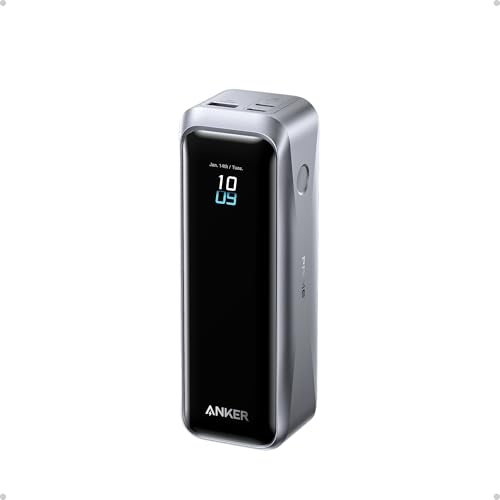
The 20,100mAh edition of the Anker Prime Power Bank provides a streamlined alternative for power users who want 140W single-port laptop charging without carrying near-limit battery volume. Rated at 72.36Wh, this flight-ready power bank provides enough energy reserve for up to 4.2 days of streaming playback on flagship mobile hardware. Its triple-port configuration includes two high-spec USB-C connections and one USB-A port, delivering up to 220W total system output across connected loads.
Single-port performance matches top-tier standards, capable of pushing 140W Power Delivery over a 5A cable to charge a 16-inch MacBook Pro to 50 percent in 28 minutes. On the input side, the pack supports a 100W maximum USB-C recharge rate that brings the internal cells to 50 percent capacity in 25 minutes, with total replenishment requiring 1.5 hours. Encased in a refined Phantom Gray chassis, this model features a built-in digital display that indicates active input and output statistics. For technical buyers analyzing an anker power bank 20000+mah, this unit represents peak power density.
This anker prime power bank concedes ground to the larger 27,650mAh model in total aggregate capacity and lacks the dual-charger 170W replenishment feature. It also does not include integrated cables like the 25K Laptop model, requiring users to carry the included 3.3-foot 240W USB-C cable in their travel kit. Nevertheless, its 220W total output and 140W single-port ceiling deliver exceptional speed-to-weight efficiency.
- 20,100mAh capacity providing 72.36Wh of TSA-approved portable reserve power.
- 220W maximum total output across two USB-C ports and one USB-A port.
- 140W maximum single-port fast charging to rapidly revive high-draw professional laptops.
- 100W high-speed input recharging the internal cells to 50 percent in 25 minutes.
Anker 737 Power Bank

Price not listed
Our score: 9.2/10Very positive
Brand Anker ASIN B09VPHVT2Z
Best for: Field professionals tracking real-time telemetry stats
Pros
- Full 140W two-way PD 3.1
- Comprehensive real-time telemetry screen
- Fast 52-minute full recharge
Cons
- Substantial 22 oz weight
- Chunky pillar form factor
The Anker 737 Power Bank, recognized as the PowerCore 24K, is a cornerstone in high-output portable charging technology. Equipped with a 24,000mAh battery pack, this unit incorporates Power Delivery 3.1 architecture to deliver full 140W two-way charging speeds. This bidirectional 140W capability means the pack can output maximum wattage to top-tier laptops and intake that identical 140W rate when recharging, achieving a complete cycle from zero to full in 52 minutes when paired with a compatible 140W wall charger and 5A cable.
Real-time operating stats are visible via an integrated color smart digital display. Rather than basic percentage lights, this display provides granular metrics on incoming and outgoing wattage per port, overall battery health, temperature, and a live countdown calculating exact recharge times. With a port array consisting of two USB-C connections and one USB-A port, it can power an iPhone 16 Pro up to 4.13 times or an iPad Pro 1.33 times. The physical casing measures 6.1 by 2.1 by 1.9 inches and weighs approximately 22 ounces, maintaining an airline-safe footprint.
Where the anker 737 power bank yields to newer Prime hardware is its total simultaneous output cap, which maxes out at 140W across all ports combined rather than splitting 220W or 250W. Its vertical pillar design also creates a heavier desktop presence compared to flat-pack form factors. For users who value complete two-way 140W symmetry and granular display telemetry, it remains an industry benchmark.
- 24,000mAh capacity fully compliant with standard airline carry-on regulations.
- Two-way 140W Power Delivery 3.1 supporting rapid charging and 52-minute full replenishment.
- Smart digital display relaying live wattage tracking, battery health, and recharge timers.
- Three-port output layout incorporating two high-power USB-C ports and one USB-A port.
Anker Nano Magnetic Power Bank

Buyer favouriteScored 9.4/10 or higher
Price not listed
Our score: 9.8/10Overwhelmingly positive
Brand Anker ASIN B0F8HXYD46
Best for: iPhone users wanting slim magnetic top-ups
Pros
- Ultra-slim 0.3-inch chassis
- 15W Qi2 wireless charging standard
- Graphene thermal dissipation system
Cons
- Modest 5000mAh total capacity
- Not recommended for Android phones
The Anker Nano Magnetic Power Bank serves an entirely different technical need, prioritizing extreme thinness and wireless freedom over workstation-level wattage. Designed around a compact 5,000mAh cell, this battery pack measures a remarkably slim 0.3 inches in thickness. It integrates Qi2 certification, enabling seamless MagSafe-compatible 15W wireless power delivery for supported iPhone models, elevating an iPhone 16 Pro to 25 percent in 42 minutes without any trailing cables.
Thermal mitigation is critical in ultra-thin inductive power hardware. Anker addresses this through internal graphene cooling sheets, dual negative temperature coefficient (NTC) monitoring chips, and intelligent heat regulation circuits that maintain operating temperatures below 104 degrees Fahrenheit. This keeps the unit 14 degrees cooler than legacy baseline standards, protecting cell chemistry and user comfort. For wired utility, its bi-directional USB-C port provides up to 20W output, and the unit completes a full wired recharge in approximately 1.7 hours.
The anker nano magnetic power bank naturally surrenders utility when matched against multi-cell laptop bricks. Its 5,000mAh capacity is built for emergency single-charge smartphone extensions, and the manufacturer listing explicitly states it is designed for iPhone and not recommended for Android hardware. For pocketable, cable-free convenience, it delivers unmatched physical refinement.
- Ultra-slim 0.3-inch profile engineered for unobtrusive magnetic attachment to smartphones.
- Qi2-certified 15W wireless charging delivering full MagSafe standard transfer rates.
- Advanced thermal structure utilizing graphene cooling and dual NTC sensors below 104 degrees Fahrenheit.
- Secondary 20W maximum wired output available through the bi-directional USB-C interface.
What Sets These Models Apart
| Model | Battery Capacity | Maximum Single-Port Output | Total Multi-Port Output Ceiling | Included Cabling |
|---|---|---|---|---|
| Anker Laptop Power Bank | 25,000mAh | 100W USB-C | 165W | Dual built-in USB-C cables (retractable and strap) |
| Anker Zolo Power Bank,20,000mAh 30W Portable | 20,000mAh | 30W USB-C | 30W | Built-in 5.98-inch USB-C cable |
| Anker Prime Power Bank (27.6K) | 27,650mAh (99.54Wh) | 140W USB-C | 250W | 2 ft USB-C to USB-C cable |
| Anker Prime Power Bank (20.1K) | 20,100mAh (72.36Wh) | 140W USB-C | 220W | 3.3 ft 240W USB-C to USB-C cable |
| Anker 737 Power Bank | 24,000mAh | 140W USB-C | 140W | 140W USB-C to USB-C cable |
| Anker Nano Magnetic Power Bank | 5,000mAh | 20W Wired / 15W Wireless | 20W | USB-C to USB-C cable |
Buying Tips for Anker Power Banks
Choosing an appropriate battery pack requires calculating your gear’s exact wattage demands and verifying whether multiple devices will pull power at the same moment. High-performance laptops generally require a minimum 65W to 100W feed to charge under active loads, while premier workstations draw up to 140W using Power Delivery 3.1 Extended Power Range profiles. If you plug a secondary device into a power bank with a low total output ceiling, the primary port often down-negotiates to 45W or 30W, leading to battery drain while you work. Selecting models with total ceilings of 165W, 220W, or 250W guarantees that your primary laptop port stays pinned at full wattage regardless of secondary accessories.
Air travel regulations represent another non-negotiable metric. The Federal Aviation Administration and TSA enforce a strict 100 watt-hour (Wh) limit on lithium-ion batteries packed in carry-on baggage without special airline authorization. Capacity ratings in milliamp-hours can be misleading due to differing internal battery pack voltages. For instance, the 27,650mAh Prime unit is specifically engineered to register at 99.54Wh, safely sliding under the 100Wh legal threshold. Always verify the stated watt-hour rating printed on the manufacturer chassis before heading to airport security checkpoints.
Finally, inspect the cabling ecosystem before finalizing which anker power bank to buy. Power banks supporting 100W or 140W delivery require electronic marker (e-marker) 5A-rated USB-C cables to unlock those rates; generic charging cords will throttle the entire circuit to 60W (3A at 20V). While integrated cable models eliminate the hassle of packing extra wires, standalone port models offer the flexibility to swap in extended heavy-duty cords suited for permanent desktop setups.